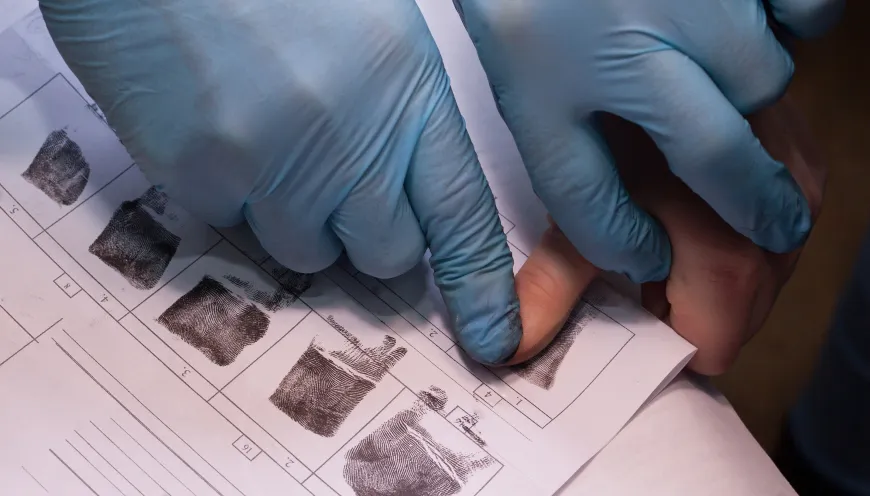
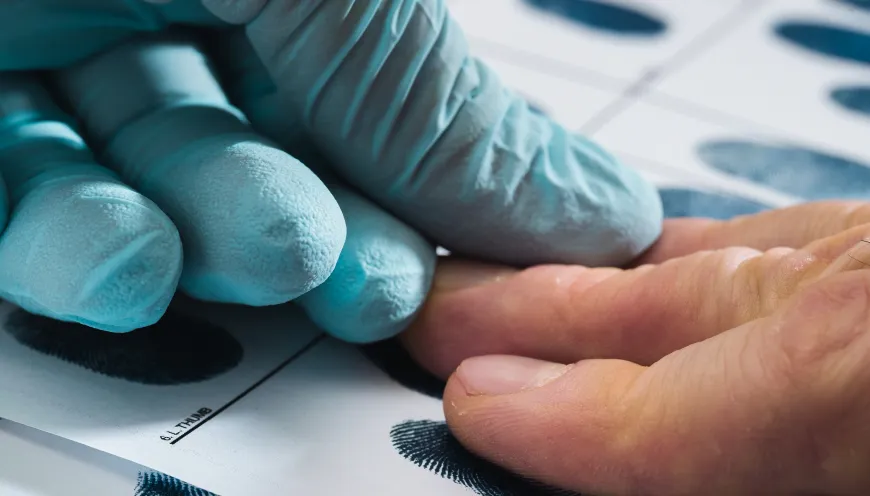
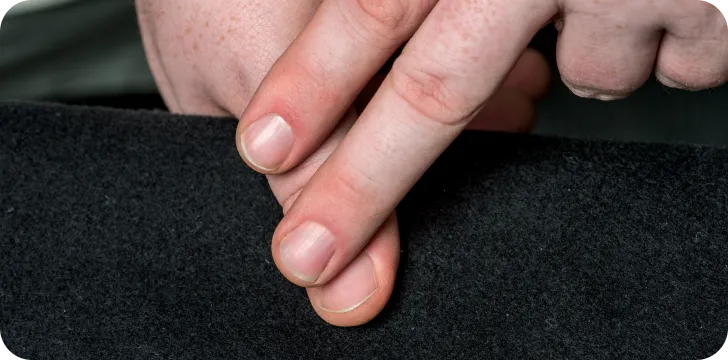
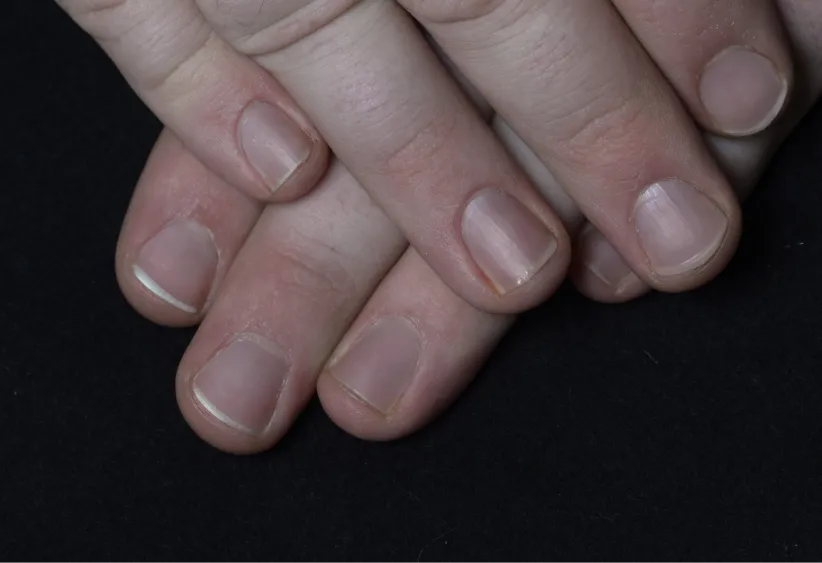
Make both rolled and plain impressions. Make these on an eight-by-eight-inch fingerprint identification card, available from your local police department or your counselor.
Making Prints
Position the inking plate at a height that lets the subject’s forearm be horizontal while the fingers are being inked. The subject’s arm may be placed on the edge of a counter or a table of counter height. With the arm in such a position, you can avoid strain and pressure on the fingers, and you should be able to make uniform impressions.
Take finger impressions on eight-by-eight-inch fingerprint cards, a size that has been generally adopted because the cards are easy to file. Complete the form as shown on the previous page.
The illustration shows two types of impressions.
Rolled Impressions
The upper 10 prints are taken individually and are known as rolled impressions.
Plain Impressions
The smaller prints at the bottom of the card are taken by printing the thumbs separately but printing all the fingers of each hand together. These are called plain impressions and are used as a check on the rolled impressions.
Rolled-Impression Fingerprinting Equipment
To make rolled and plain impressions on a fingerprint identification card, you need the following equipment.
Black printer’s ink gives the best results because it dries quickly. You can handle fresh work immediately with little danger of smudging. Plain writing ink or ordinary stamp-pad ink is not satisfactory; prints taken with such inks usually are illegible.
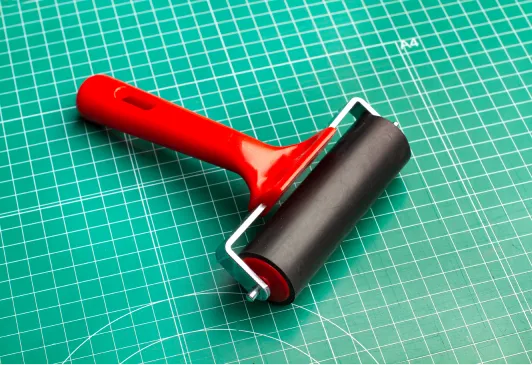
The roller best suited to fingerprinting work is similar to the rubber roller that printers use to apply ink to a press.
A metal plate or an ordinary piece of glass one-quarter-inch thick, six inches wide, and 12 to 14 inches long makes a good inking plate.
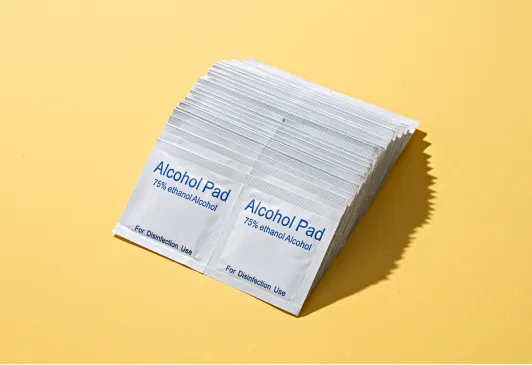
You will need cleansing fluid and a cloth to prepare the subject’s fingers and to clean the roller and inking plate thoroughly after each use. Denatured alcohol works well as a cleansing fluid.
You can get paper fingerprint cards from your local police department. Be sure to ask for the personal identification type.
Many local law enforcement agencies will provide FBI fingerprint cards (FD-258) at no charge, especially to residents who need them for official purposes (background checks, volunteer work, licensing, etc.). It’s important to call ahead to confirm because not all departments offer the cards or take prints.
Some government agencies and licensing boards will mail free blank FD‑258 fingerprint cards if you request them or if they are needed for an application. You must contact the specific agency to ask for the cards.
Office supply retailers (Office Depot, Staples, Walmart, Target, etc.) sell fingerprint ink pads online and often in stores across the U.S.—you can order online and pick up or have them shipped to you.
Online marketplaces (Amazon, Etsy, Walmart.com, BestBuy.com, etc.) offer a range of fingerprint ink pads.
Rollers:
Rubber (brayer) rollers for engraving can be found at Walmart, Amazon, and craft stores.
Using Fingerprint Cards: Rolled and Plain Impressions
Rolled Impressions: Step-by-Step Guide
1. Prepare the Ink
Place a small amount of printer’s ink on the inking glass or plate.
Roll Out the Ink using a brayer to roll the ink back and forth evenly. Continue until the ink forms a thin, smooth, velvety film with no streaks or bubbles.
Helpful tip:
Properly prepared ink should be slightly “tacky” when rolled, not wet.
2. Position the Subject
Have the subject stand directly in front of the inking plate, about a forearm’s length away.
Make sure their hands are clean and relaxed.
3. Ink the Finger
Place the entire first joint of the finger on the inked plate.
Keep the plane of the fingernail at a right angle to the surface of the plate
Roll the finger from one edge of the nail to the other in a single, continuous motion.
Do not roll back and forth.
Ensure the ink covers the finger evenly from the tip to just below the first joint.
4. Roll the Finger on the Card
Lift the finger from the inking plate and carefully position it on the fingerprint card.
Using the same single rolling motion, roll the finger until the bulb faces the opposite direction.
Follow the correct rolling direction:
Thumbs: Roll toward the center of the body.
Fingers: Roll away from the center of the body.
This keeps the fingers relaxed and allows you to lift them cleanly without smudging the print.
Remember to press the finger lightly. Applying too much pressure can distort the print.
Helpful Tip
Print Fingers in Order
To ensure consistency, ink and roll each finger separately, in this order:
Right Thumb
Right Index Finger
Right Middle Finger
Right Ring Finger
Right Little Finger
Then repeat for the left hand in the same order.
Plain Impressions
To take plain impressions, lightly press all the fingers of the right hand on the inking plate, then press them simultaneously at a 45-degree angle on the card in the space provided. After doing the same thing with the left hand, ink and print the thumbs of both hands.
To record plain impressions, ink fingers as shown; do the same with the thumb.
Print the plain impressions by placing inked fingers on the card at the same time.
Finishing the Card
There is more to do in preparing a fingerprint card than just taking the subject’s finger impressions. You must type or plainly print the subject’s name, age, date of birth, sex, and other identifying information on the fingerprint card, as soon as possible after fingerprinting.
Helpful Tip
If any of the subject’s fingers are amputated, mark the space for the missing finger “AMP.” If any of the fingers cannot be printed because of cuts, burns, or bandages, print them later.
Now that you have learned how to make rolled- and plain-impression fingerprints,