Take a clear set of prints using ONE of the following methods:
Take a clear set of prints using ONE of the following methods:
Taking Fingerprints
Your Fingerprinting merit badge counselor may have you take fingerprints at a police station, a unit meeting, or another convenient place, and they may provide the equipment. If your unit gathers its own materials, you can use them for demonstrations or shows. Traditional fingerprinting uses black ink, a roller, an inking plate, and fingerprint cards. A card holder can help prevent smudging but isn’t required. You may complete requirement 4 by taking fingerprints on a standard card or by using lifting tape—both methods work.
Latent Prints
Anytime people touch an object with their bare hands, they transfer some perspiration and body oils to the object, leaving a fingerprint or palm print. These prints are latent prints—usually they are invisible or only partially visible.
Dusting for Prints
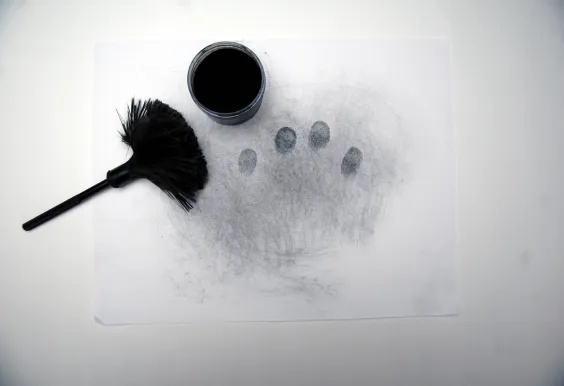
Latent impressions on hard surfaces such as glass, metal, or furniture can be developed (made visible) by dusting with fine powder. The fingerprint expert uses the tip of a brush to carefully apply a colored powder to the surface. The powder sticks to the oils in the print and makes the print show up. When the latent print becomes visible, it can be photographed for preservation.
Prints Lifted by Sticky Tape
The print also can be “lifted” from the surface with sticky tape and fixed onto a card as a permanent record. Latent prints on porous surfaces such as paper, cloth, and unpainted wood may be chemically developed. Different chemicals react with different substances that may be in the print, such as oil or fat, acids, or salt. The reactions make a colored image show up; this image can then be photographed.
Laser Light Prints
Special X-ray techniques can make fingerprint impressions on skin become visible. Some latent prints can be developed only with a laser, a device that emits a powerful ray of light. The laser light makes the perspiration in a fingerprint shine, and while it shines the print can be photographed.
Now that you have learned more about latent fingerprints,
let’s learn how to make rolled and plain impressions of fingerprints using a fingerprint identification card.