Discuss how air pollution and transportation affect each other by giving at least three examples. Then, compare two modes of transportation (e.g., gasoline-powered v. electric vehicles, gasoline-powered car v. bicycle, etc.).
Air Pollution and Transportation
Transportation is a major source of air pollution because cars, trucks, and buses release exhaust that adds harmful pollutants to the air. In turn, air pollution drives changes in transportation, such as cleaner fuels, emission standards, and the shift toward electric vehicles and public transit.
Air Quality Impacts of Different Transportation
What Comes Out of a Car Exhaust?
Air Pollution Solutions
Air pollution from transportation can be reduced in various ways. For example, catalytic converters are devices installed in vehicle exhaust systems that convert harmful gases, such as carbon monoxide and nitrogen oxides, into less harmful substances before they are released into the air. Hybrid vehicles use a combination of an internal combustion engine and an electric motor, which reduces fuel use and lowers emissions compared to traditional gasoline-only cars. Electric vehicles completely avoid combustion of gasoline, so they create no local emissions. However, depending on the source of the electricity, there can be air pollution at the generating power plant.
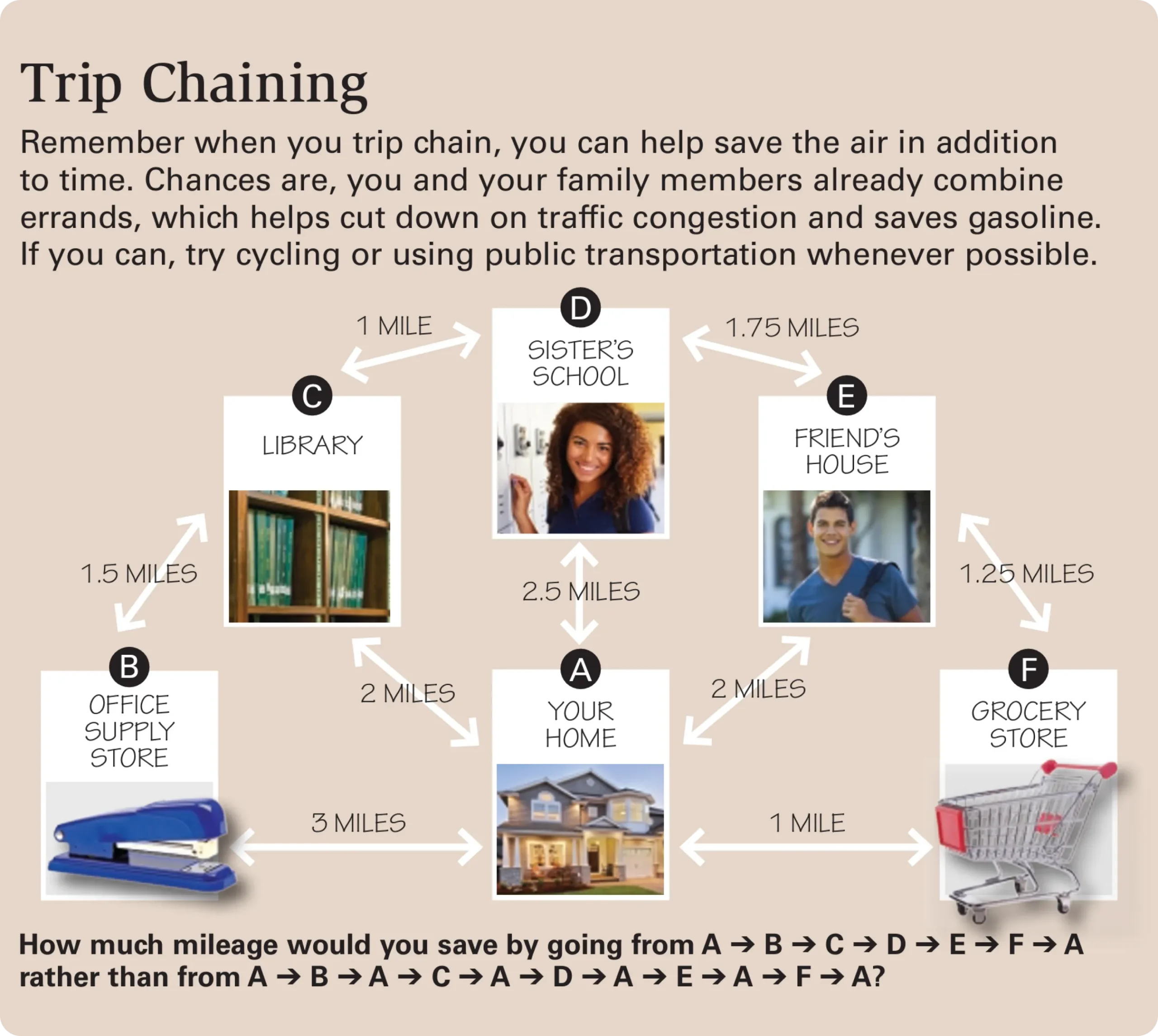
Trip chaining is a travel strategy where multiple errands are combined into one journey instead of several separate trips, which reduces the total number of miles driven and cuts down on fuel consumption and exhaust emissions. Together, these solutions help lower the amount of air pollution produced by transportation.
Prepare for a discussion on how air pollution and transportation affect each other with a role-play. Find a buddy to role-play a conversation between two types of transport.
Research and prepare in advance some of the facts you would want to share. What might you consider? Emissions, energy source, efficiency, and health impacts? Anything else? Liaise with your role-play partner so you have similar information. Identify the benefits and downsides of your type of transportation.
At the end of the role-play, encourage people watching to identify the type of transport that was better for air pollution.
Make some notes comparing the two types of transport, including your own research and what you learned from your role-play partner.
Now you’re ready to discuss with your counselor how air pollution and transportation affect each other.
Procedure
1. Prepare Collectors:
Draw a grid with 1-inch squares on two white index cards or paper plates. Label them. Spread a thin layer of petroleum jelly on one side of each.
2. Placement:
a.Choose a week when the weather forecast is mild. b. Place one in an urban area (near a busy road) and one in a nonurban area (a field or forest) or one indoors and one outdoors. c. Place them at the same height to control for any height difference in particulate. d. Choose locations that allow air to flow freely, yet protect them (e.g., under an overhang). e. Fasten them securely with tape or staples.
3. Wait:
Leave the collectors for one week to gather airborne particles.
4. Analyze:
Use a magnifying glass to inspect the debris. Count particles in four squares to find the average per square inch. Note the color and shape (jagged, round, fibrous, etc.) of the particles. Use the template to record your observations. Report to your counselor what you learned about how particulate matter contributes to air pollution in urban and rural or indoor/outdoor environments.
Helpful Tip
Localize your comparison: Before you start, undertake a community observation to identify transportation choices where you live.
Safety Reminder
Safety Reminder
Always choose a safe location to observe transportation.
Now that you have learned how transportation can affect air pollution,