Give a short history of fingerprinting. Tell the difference between civil and criminal identification.
Give a short history of fingerprinting. Tell the difference between civil and criminal identification.
History of Fingerprinting
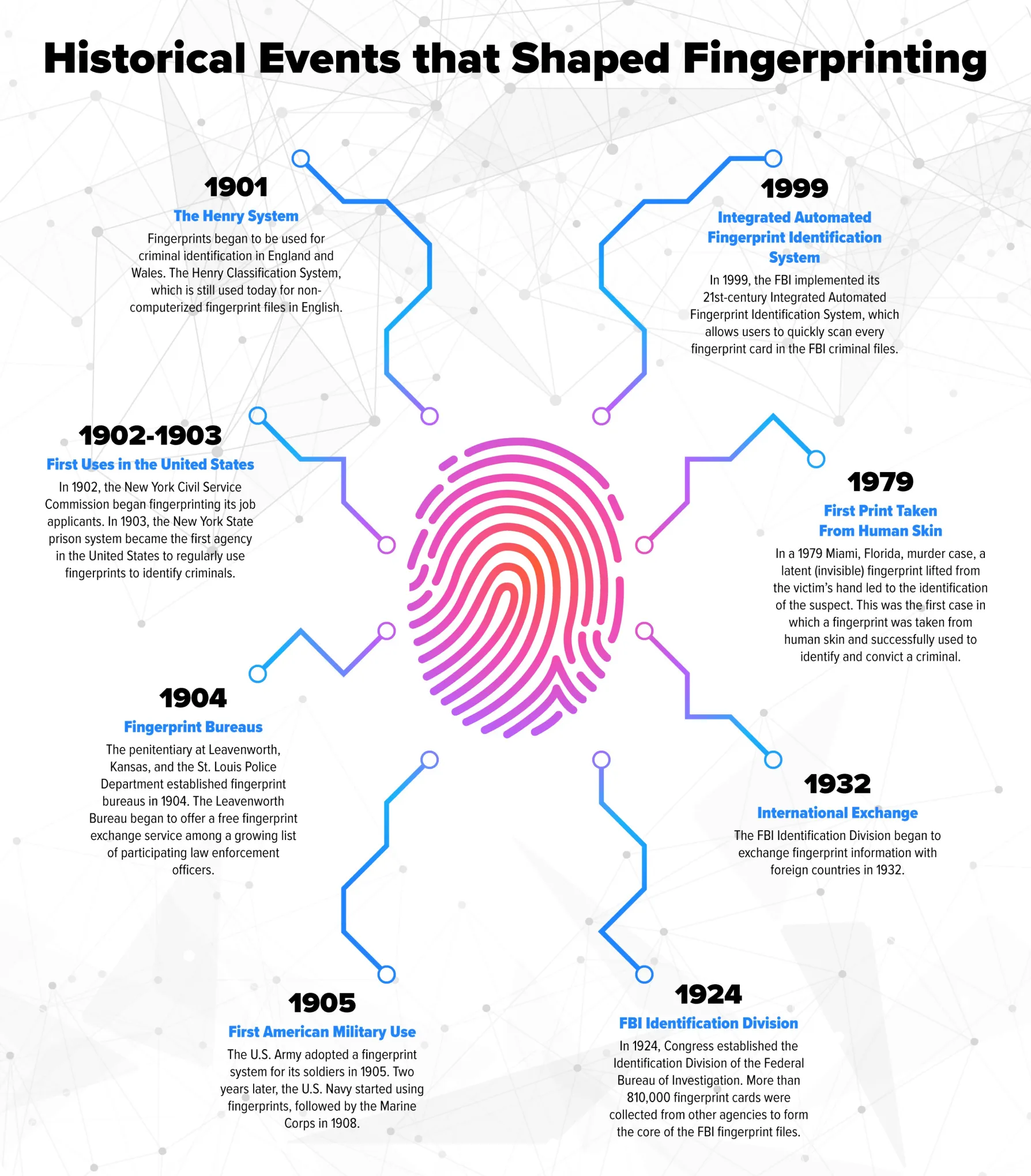
People have recognized the ridge patterns on fingers and palms for thousands of years. Prehistoric carvings in Nova Scotia, Canada, show hands with visible ridges, and the Chinese used thumbprints to seal documents for centuries. In 14th‑century Persia, officials even used fingerprints on government papers, noting that no two prints were alike. Despite this early awareness, the scientific study of fingerprints did not begin until about three centuries later. The following is a brief summary of the key discoveries that shaped modern fingerprinting.
Exploring the History of Fingerprints
Fingerprint Processing Today
In 2011, the FBI began a multi-year Next Generation Identification (NGI) project to expand the capabilities of and to replace the Integrated Automated Fingerprint Identification System (IAFIS). The NGI system allows fingerprint matching to 99.6 percent accuracy, faster response times of less than 10 seconds, palm-print searches, photo storage from state repositories, facial-recognition searches, and iris searches. In January 2024, the FBI received an average of more than 170,000 fingerprint sets daily.
FBI’s Next Generation Identification (NGI) system
The advanced biometric identification system that replaced IAFIS and includes fingerprints, palm prints, facial recognition, and more.
Integrated Automated Fingerprint Identification System — 1999
In 1999, the FBI launched IAFIS, a computerized system that can scan and search all fingerprint records in hours instead of the 40 days needed for manual checks. It also allows agencies to send fingerprint data electronically. The first phase, AFIS, compared prints against about 70 million criminal records, while civil files continued to be stored manually.
The IAFIS is the largest person-centered database in the world with over 40 million records, providing automated fingerprint searches and exchanges and text searches of information.
Next Generation Identification (NGI): Today’s Fingerprint Technology
In 2011, the FBI began developing the Next Generation Identification (NGI) system to replace IAFIS. NGI offers 99.6 percent accurate matches, responses in under 10 seconds, palm‑print and facial‑recognition searches, iris matching, and access to photo databases. Today, the FBI holds more than 250 million fingerprint records and, as of January 2024, receives over 170,000 fingerprint submissions each day.
The Path of a Fingerprint: From Discovery to Courtroom Proof
Civil Identification
Civil identification refers to fingerprinting that is done for non‑criminal purposes. Its goal is to verify a person’s identity for records, licensing, or background checks.
Common examples include:
Employment background checks
Security clearances
Immigration or citizenship applications
Professional licenses (teachers, nurses, etc.)
Adoption or volunteer screening
Key points:
The person being fingerprinted is not accused of a crime.
The fingerprints are used for identity confirmation, not investigation.
The process is usually voluntary or required by a job or agency.
Criminal Identification
Criminal identification is fingerprinting used to solve crimes or maintain criminal records.
It is used for:
Identifying a suspect at a crime scene
Checking if a suspect has a prior criminal record
Documenting fingerprints when someone is arrested
Key points:
The purpose is to link a person to a criminal act.
Prints may be taken from a person under arrest or lifted from a crime scene.
The fingerprints become part of a criminal history record.
Did You Know:
Did You Know:
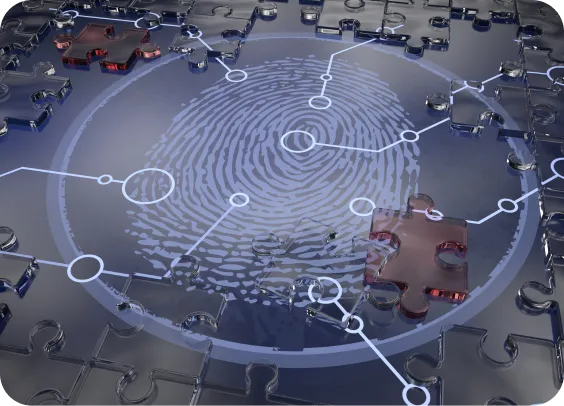
A Fingerprint Jigsaw
A man was arrested for trying to enter the United States illegally. His fingerprints showed he had intentionally scarred his fingertips, which raised suspicion immediately: Why would he do that unless he had something to hide?
Suspicious authorities sent the suspect’s prints to the FBI, where a fingerprint examiner discovered that the man had had several triangles of skin cut from each finger and surgically rearranged. The examiner enlarged the prints, cut them apart, and pieced them back together in their original positions like a jigsaw puzzle.
The rebuilt prints matched a set in the FBI’s vast fingerprint files, identifying the man as a fugitive who had been convicted on a drug charge years earlier. If the man had been able to hide his true identity, he would have served no more than six months for having an illegal passport, rather than the 25-year sentence he got for the drug conviction.