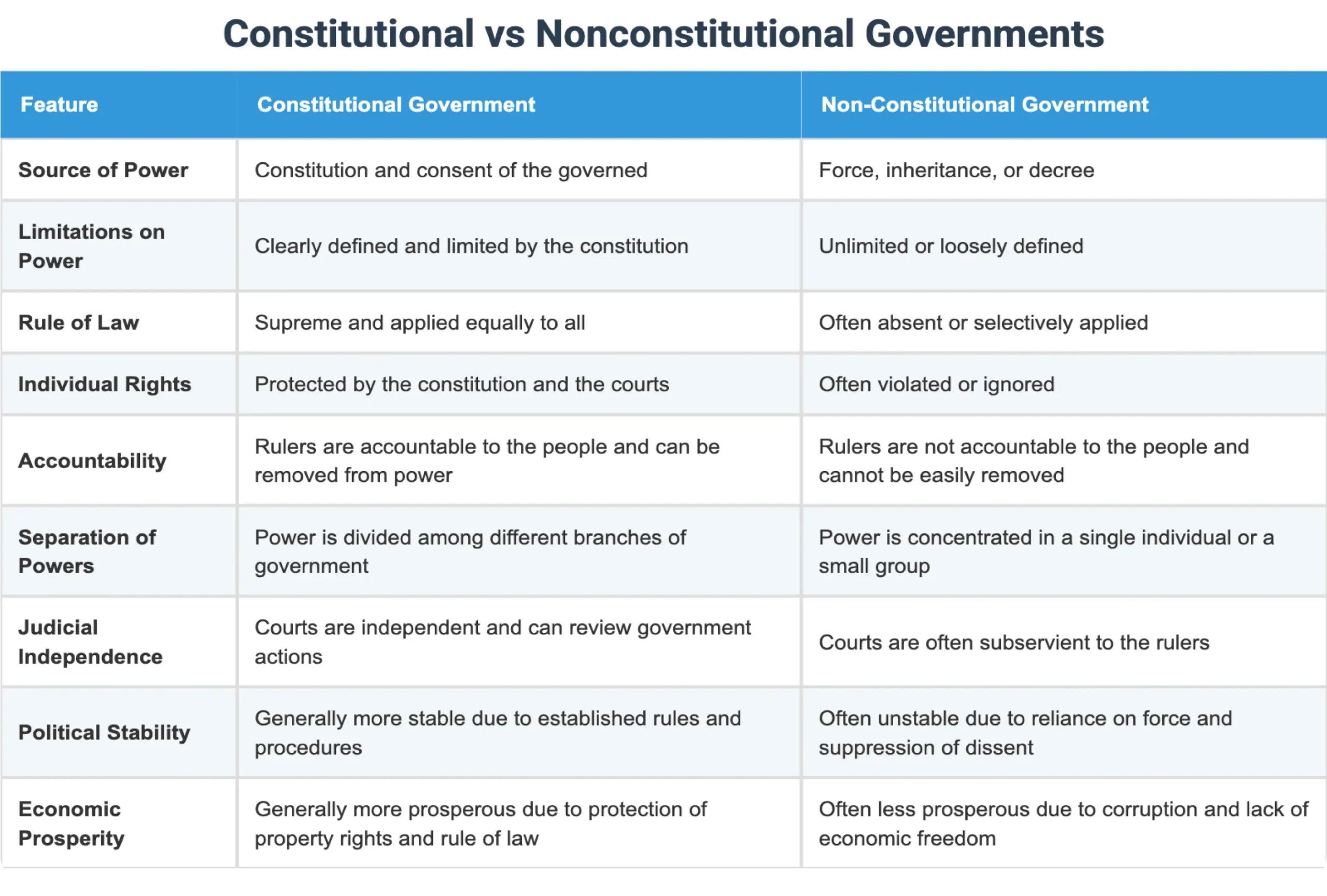
Discuss the differences between constitutional and nonconstitutional governments.
Constitutional Governments
To be considered constitutional, a government must meet three requirements. It must be limited in its power, follow controlling laws, and have constitutional stability.
Limited Power
The concept of limited government, also called the rule of law, holds that the government and its officers may not exceed the limits of their power. They are subject to—and never above—the law. If they violate the law, the Constitution specifies ways to remove them from office.
Controlling Law
In a constitutional government, the constitution is considered the controlling law of the land. It has two important characteristics.
Individual rights are protected from infringement by the government and other people. For example, citizens are protected against illegal search and seizure.
It provides limitations on power. This is achieved by separating powers through checks and balances.
Constitutional Stability
The constitution cannot be changed without the consent of citizens and without using well-known, established amendment procedures.
Understanding Nonconstitutional Systems
An authoritarian government—in which the authority to rule is concentrated in the hands of an autocratic leader or an oligarchy—acts arbitrarily. Neither constitutionally bound nor responsible to the people, the government rules without restraint or limitations. It remains in control if it pleases, or until it is overthrown. Authoritarian governments are not always heavy-handed. In certain cases, a leader may rule as a benevolent dictator, acting for the good of the people. This oppressive form of ruling power controls every aspect of life.
Even though a nation may call itself a “democratic republic,” this does not mean that the actual government in practice is constitutional. This is the case with the Democratic People’s Republic of North Korea, where Kim Jong Un rules as a Communist dictator. The late Fidel Castro had a similar role for more than 30 years in Communist Cuba, where the only political party is the Partido Comunista de Cuba (Cuban Communist Party).
Nonconstitutional governments also exist in nations such as Saudi Arabia, which is run by an absolute monarchy.
Now that you have learned more about the differences between constitutional and nonconstitutional governments,
let’s identify five different types of governments currently in power in the world.