

- All
- Aquatics
- Awards
- Biking
- Camp Staff
- Camping
- Conservation & Environment
- COPE/Climbing
- Cub Scouting
- Fishing
- National Jamboree
- National Outdoor Conference
- NCAP
- Outdoor Ethics/Leave No Trace
- Outdoor Programs - General
- Properties
- Range & Target Activities
- Safety
- Shooting Sports
- Special Needs
- Sponsored Content
- Wheels & Board Sports
Camping
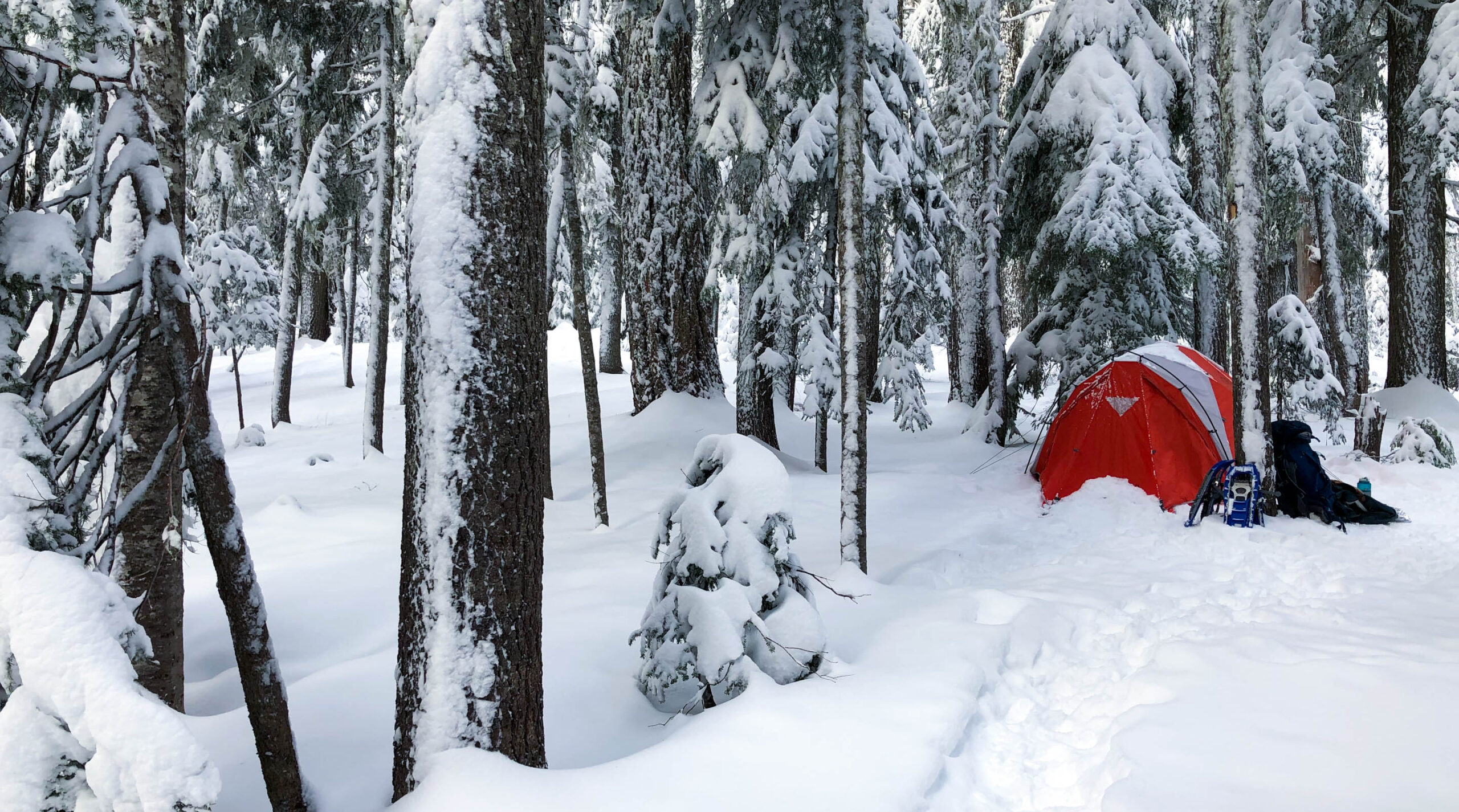
Winter camping with a Scout unit of 20 to 40 Scouts can be an incredible adventure. However, the potential for environmental impact increases significantly with larger groups, especially in fragile winter ecosystems. Practicing Leave No Trace (LNT) principles is essential to ensure the natural world remains undisturbed. Here are some tips to help you plan and execute a responsible winter camping trip:
Planning Ahead
Preparation is the foundation of Leave No Trace camping. Winter environments can be harsh, so careful planning is critical for both safety and minimizing environmental impact.
- Research the Area: Select a campsite that can accommodate your group without causing excessive impact. Check local regulations and guidelines.
- Know the Conditions: Monitor weather forecasts and ensure everyone packs clothing and gear suitable for freezing temperatures, snow, and ice.
- Divide and Conquer: Break the group into smaller patrols to minimize the impact on any one area.
Choosing a Campsite
Winter landscapes are delicate, with snow-covered vegetation and fragile ecosystems beneath. Proper site selection is crucial to prevent long-term damage.
- Stick to Trails: Travel on established trails or deep snow to avoid damaging underlying vegetation.
- Choose Durable Campsites: Camp on snow, ice, or bare ground, and stay at least 200 feet from water sources to protect riparian zones.
- Avoid Sensitive Areas: Stay away from meadows, young trees, and wildlife habitats. Rotate high-traffic areas within your camp to prevent snow compaction and damage.
Managing Waste
Improper waste disposal can harm wildlife and pollute water sources. Responsible waste management is a core LNT principle.
- Pack It In, Pack It Out: Carry out all trash, including food scraps, in sealable bags. Don’t leave anything behind.
- Dishwater Disposal: Strain dishwater to remove food particles, scatter the water away from camp, and pack out any solid waste.
Using Fire Responsibly
Campfires can scar the environment and deplete natural resources. Limit their use and focus on sustainable practices.
- Use Stoves: Opt for camp stoves over fires for cooking and warmth whenever possible.
- Fire Rings: If fires are permitted, use established fire rings or build a mound fire on durable surfaces like snow.
- Limit Firewood Use: Gather only small, dead wood from the ground and completely extinguish fires before leaving.
Respecting Other Visitors
The wilderness is a shared space. Show respect to others to ensure everyone has a positive outdoor experience.
- Yield on Trails: Step aside for smaller groups or individuals and avoid creating deep ruts with snowshoes or skis.
- Leave It Better: Sweep the area for litter or damage, even if it wasn’t caused by your group.
Special Considerations for Large Groups
Larger groups naturally have a greater impact, so additional precautions are necessary to reduce their footprint.
- Educate Participants: Before and during the trip, remind Scouts of Leave No Trace principles and encourage adherence.
- Share Gear: Minimize duplication by using communal tents, cooking equipment, and other shared items.
By diligently applying Leave No Trace principles, Scout groups can enjoy the unique challenges and beauty of winter camping while preserving the wilderness for future generations.

Camping
This will be a continuing series of articles on various aspects of the properties we own, lease, care for, and look to make better. As we all know, the program of Scouting is valuable to the growth of youth in this country and around the world. Where we deliver that program needs to convey that value and the coming articles are intended to assist us all in making that conveyance to our current users, as well as all our future users and their families.
In the last edition of Let’s Do Better, we discussed forests and the trees that make up those wonderful places folks in this organization like to spend quality time in! And while we talked about replanting and harvesting the various species that grow within those forests we didn’t talk very much about protecting them. Sure, we could talk about cutting break lines in case of fire. Installing roads through the forests so there’s access should fire occur (these can be minimal and combined with a break line is ideal). Maintaining a forest stand is a whole lot more than just cutting out the dead wood! But, how else can we protect this precious asset? Property Insurance.
Little thought was given to how complex and involved the topic of insurance was going to be. Like many, we know it’s a good idea to ‘carry’ insurance. Yes, we do pay for it. Why? No, not why do we pay for it. Why do we ‘carry’ it? Why do we pursue having insurance in the first place?
“Insurance is a means of protection from financial loss.”
That’s a line from the Wikipedia article on insurance much of this month’s article is based upon. A means of protection from financial loss.
The idea of insurance if you will, is quite old. In fact, similar “transferring or distributing risk” was practiced in the 3rd and 2nd millennia BC. Traders in that day spread their goods across several transport vehicles with the expectation that one or more of the transports would not make the journey. The vehicles at the time were vessels on the rivers and streams by which traders moved their goods to a market. A few factors could possibly overturn a vessel and the cargo was lost. In this way, the trader insured at least some of his goods made it to market, if not all.
“The law of general average constitutes the fundamental principle that underlies all insurance.”
Tablets from the dynasty of Nerva-Antonine in the ruins of the Temple of Antinous in Aegyptus (Egypt) in approximately 133 AD during the reign of Hadrian of the Roman Empire prescribed rules and membership dues of a burial society. In essence, early burial insurance. Other concepts of insurance have been found in 3rd century BC Hindu scriptures. In ancient Greece they developed marine loans in order to ensure their cargo was delivered in order to receive payment in full. The idea of a separate contract to insure something was invented in the 14th century in Genoa. Life insurance to cover a person was not created until 1583, in London. Property insurance can be traced to the Great Fire of London in 1666 which consumed more than 13,000 homes. In fact, in the 1680s the first fire insurance company was established at the back of the Royal Exchange, the very place the first life insurance policy was written. As London grew as a center for trade the demand for marine insurance increased. Edward Lloyd saw the opportunity, opened a “coffee house” whereby shippers would meet with folks who were willing to underwrite a shipment thus creating Lloyd’s of London as an insurance market.
So, even though insurance has been around for centuries, most of the varying types of insurance we know today have really been developed since the late 18th century. Even today new types of policies are created in response to world events.
But the question remains, why? Insurance is basically a pooling of funds from many, to pay for losses incurred by a few. Most of us have car insurance. We pay monthly premiums, the pool, and file a claim when we encounter an accident. If the claim meets the terms of the policy, we’re paying premiums on, the insurance company pulls from that pool of funds we’ve been contributing to along with many other drivers and pays us, or the company repairing the damage, what’s required to fix, or “make whole again” what we possess. Then we can drive our newly repaired vehicle down the road again. Easy enough, right? The line, “If the claim meets…” is loaded with a lot of subjects to be dissected a bit to better understand the purpose of this month’s article for Let’s Do Better when looking at our property insurance!
You all know that numerous insurance companies exist. We do have a choice when it comes to the purchase of insurance in whatever form we’re looking to acquire. And to say there’s a choice is a big understatement! Insurance companies exist because they make money. In 2020, insurance companies in the US of A had $2.5 trillion in direct premiums written. Yes, that’s trillion with a ’T’! That’s a bunch of billions, and a whole lot more millions. You all also know that when you file a claim the expectation is one of apprehension as to the effort it’s going to take to get something out of the insurance company to help you pay for your loss. But yet, they have trillions!
Also remember you entered into this contract, the policy, with the insurance company. You pay premiums for the coverage which should be stipulated in that contract. The insurance company when you file a claim has to examine the terms of your contract with them, see that it meets the terms of paying you for your loss, and then distributing funds. This all takes time as you are not the only person insured. As all of the contracts, policies, are not the same clarifying the loss and how it meets the terms of it may be more involved than a simple “I was in an accident. I need to repair my car. Please pay me so I can repair my car and get on with my life” scenario. Why is that?
Again, you are one of many paying into a pool of funds by which claims are drawn from.
Given some of the catastrophic events that have occurred, the insurance companies cannot just pay every claim as each needs to be vetted and shown to be accurate and true. Some insurance companies have gone out of business as they exceeded the funds to pay claims on. Not a good scenario for you in that one! So, again, why mention this?
You need to pay attention to several items when purchasing property insurance. Plain and simple.
Are you purchasing the correct type of insurance contract (policy) for what it is your
insuring? What’s the value of the item your insuring? The value today and if it’s an item that appreciates, the value in the coming years. This is what you are protecting! This is the potential loss item. What are the parameters that you and the insurance company agree to for your potential loss? This would be the terms under which the insurance company will reimburse you for the loss of the item insured.
And that is where a lot of folks get confused and where the unhappy circumstances of trying to get that reimbursement come from. You simply don’t understand the terms you agreed to! And you wouldn’t be alone in that! More than likely, you wanted a low premium. But, from the insurance company side you’re contributing to the pool a little, but when you make a claim, the expectation is the company will pay you fully for your loss. From their side you haven’t contributed enough to the pool to be compensated that way and if you looked at your contract that’s probably what it says. That’s where all the data the companies collect nowadays is crunched over and over again so they know practically to the penny what an accident like you’ve experienced should cost them. That’s how they figured your contract to protect the item you’re insuring and the terms of that protection.
So, next time you’re in the market for insurance, what are you going to look at? What questions will you ask and how closely are you going to examine the contract/policy? Yes, you want protection, but you want it fairly and to where it will adequately cover your loss.
Several councils in the organization have experienced devastating fires on their properties in recent years. They’ve lost buildings. They’ve lost the forests which grew on the property. They’ve lost the business side of the operation which has affected their financial position. Hopefully, we’ve all learned that some were better insured than others and have made appropriate adjustments to what our property insurance contracts cover. Pay attention to the terms of those contracts and what can be expected in the “to make whole again” process. Are you paying for simple coverage, or are you paying for replacement cost coverage? With the cost of materials and labor rising the way they are today, pay that extra so you can get your property back up and running more completely! Be sure to obtain the contract that best protects you and what your insuring. Insurance is not necessarily all that complex, but in many ways it helps all of us manage our property assets so we are minimally exposed to a substantial loss. And that protects us all!
See you next issue!
Dave Cornell
Architect
Mar ’22
The Outdoor Programs / Properties Team is ready to assist and guide in any respect to making the program of Scouting the best youth program! Reach out to any member of the team and we’ll endeavor to provide quality answers to any issue you may have and/or facing. We look forward to working together to make the program the best ever!
Aquatics
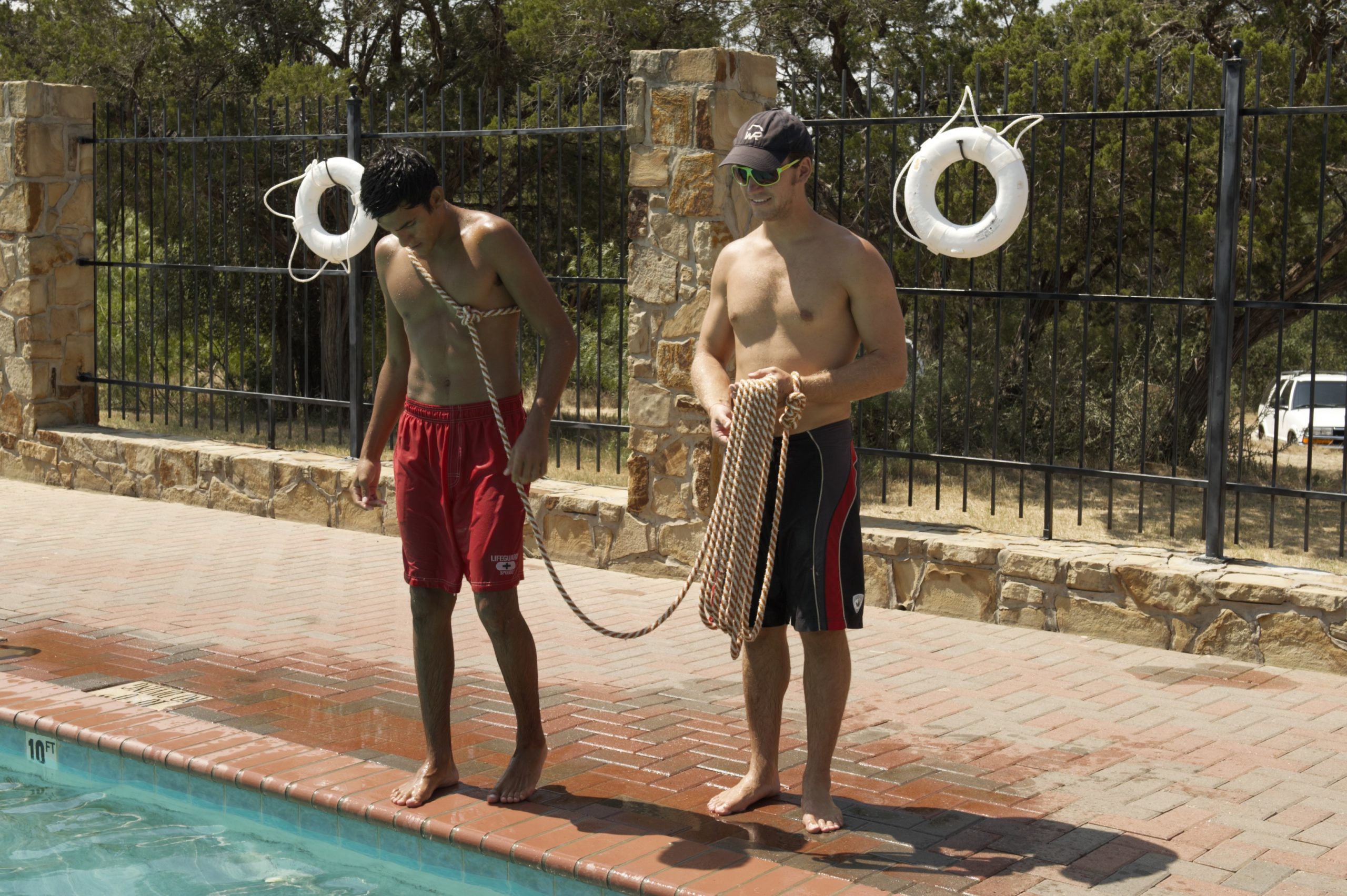
Industry practices for facility lifeguards require the venue, such as a council camp, confirm and document lifeguard competency specific to that location. Simply checking that a lifeguard has a valid certification is not sufficient to meet current standards of care. Those expectations are reflected in NCAP standard SQ-406:
C. Aquatics area staff. The following requirements apply to aquatics area staff:
- All aquatics lifeguarding staff are tested for competency by the aquatics director before assuming lifeguarding or instructional duties. The aquatics director shall keep written documentation of staff and the areas and activities for which they are qualified. Staff in training may not work unsupervised until approved in written documentation by the aquatic’s director. The required skill competencies for lifeguarding include:
- All lifeguards can reach the bottom at the deepest part of the swimming area.
- All lifeguards can reach the furthest extent of their assigned zones within 20 seconds.
- All lifeguards can currently perform water rescue skills (possession of a lifeguard training certificate is not enough; each aquatics director must check that they can still perform to standards).
- All lifeguards can currently perform BLS and first-aid skills (possession of a card is not enough; each aquatics director must check that they can still perform to standards).
- All lifeguards must be trained to execute written emergency action plans specific to local camp swimming areas and activities.
- All lifeguards respond to bloodborne pathogen incidents according to the OSHA-mandated exposure control plan.
To meet those requirements, lifeguard assessment and preservice training, at a minimum, should include:
- Rescue of an active victim, at or near the surface in deep water. This rescue to include victim recognition, emergency action plan (EAP) activation, entry, approach, rescue, and assisting the victim from the water. Each skill must be performed consecutively, not individually.
- Rescue of a passive victim, at or below the surface in deep water. This rescue to include victim recognition, EAP activation, entry, approach, rescue, victim extraction, and after care, including CPR, following camp procedures. Although not specifically required by SQ-406 C, it is appropriate to record the time from EAP activation to beginning of CPR and repeat the exercise if that time exceeds 90 seconds, as specified in Scouting America Lifeguard requirements 16 and17. Each lifeguard must be evaluated on both the rescue and the ability to perform CPR. However, the same person need not do both in the same scenario. A team response is preferred. Anyone demonstrating CPR must use proper personal protective equipment (PPE).
- Scenario based rescues are encouraged, with each lifeguard having to react to the situation rather than everyone doing the same rescue one after the other. If victims are placed at the furthest extent of the largest zones, and submerged at the area’s maximum depth, then SQ-406 standards a. and b. may be assessed at the same time as rescue skills. Otherwise those should be tested individually.
- Spinal injury management, including in-line stabilization in both shallow and deep water and spinal backboard extraction, is also a critical lifeguard exercise. Since a team approach is needed, it should be part of pre-service training for the entire safety team following procedures in a written EAP.
- For camps where swimming is conducted in murky water, the safety team must also receive pre-service training in the camp’s written EAP for a lost bather. Ideally, the safety team should recover a submerged dummy, or item of similar size and weight to that of an actual person, placed in an unknown position.
- The safety team should review the camp’s exposure control plan for blood borne pathogens and practice using both PPE and clean-up materials as specified in that plan.
Lifeguard assessment and preservice training exercises are similar to those conducted as part of a lifeguard training course. The skill sheets in the current American Red Cross Lifeguarding Manual, which is the text for Scouting America Lifeguard, provide the performance standards. The Scouting America Lifeguard Instructor Manual, supplemented by the American Red Cross Lifeguarding Instructor’s Manual, provides evaluation guidance. Therefore, lifeguard assessments and preservice training should be conducted by a current Scouting America Aquatics Instructor, Scouting America Lifeguard Instructor or American Red Cross Lifeguard Instructor.
The facility lifeguard skill assessment and preservice training differs from a lifeguard training course in that the exercises are conducted at the facility where the lifeguard serves. The exercises involve the facility safety team, facility rescue equipment and follow that venue’s written EAPs. Therefore, camp lifeguard assessments and preservice training should be conducted at Camp.
Note that SQ-401 C also requires documentation. The camp aquatics director should have a copy of each lifeguard’s training certificate. Assessments and preservice training exercises should be recorded on a check-off form noting the skill, each

NCAP
Camps are designed to be a place for fun, adventure, and personal growth. Unfortunately it is also a time when mental health concerns can arise. As camp leaders, unit leaders, and staff, it is essential to be equipped with the knowledge and resources to support campers and staff who may be struggling. We are not mental health professionals, but we can all watch and see if challenges arise – not just during summer camp but throughout the entire year.
Why is this important? Mental issues are serious and can affect individuals of all ages, including children and teenagers. Suicide is the second leading cause of death among individuals aged 10-24. September is Suicide Prevention Month, a critical time to focus on raising awareness and providing support for those at risk. As adult volunteers in Scouting, it is essential to be equipped with the right resources and knowledge to support the well-being of the Scouts. One key resource is the National Suicide Prevention Lifeline, available 24/7 at 1-800-273-8255. This lifeline offers free and confidential support, prevention and crisis resources for individuals in distress, and best practices for those providing assistance. Additionally, the Crisis Text Line is available 24/7 by texting “HELLO” to 741741, connecting individuals with trained crisis counselors.
So, what can I do to help you might ask?
- Post resource numbers like the ones listed above around your camp properties, even during events this fall and winter.
- Encourage older Scouts BSA, Sea Scouts and Venturing members to view the Personal Safety Awareness Video focused on Suicide Prevention. You can access the video and discussion guide here. You could even host a camp staff meeting and use this as the topic.
- We all need to make certain that all camp staff are trained in recognizing the warning signs. Staff need to know how to respond to a camper in crisis, and the importance of seeking help from mental health professionals. Make certain that your camp has a plan (NCAP Recommended Practice 551), even as part of short-term camps this fall and winter.
- Promote campers to the importance of self-care practices, such as mindfulness, relaxation techniques, and healthy coping mechanisms. Encourage physical activity, time outdoors, and social connections as ways to improve mental well-being. Not only promote this, but also lead by example. Staff and unit leaders need to set an example by taking care of themselves.
- Encourage camp staff and volunteers to take “Mental Health First Aid” or other similar training before summer camp next year. The “off-season” is a great time to take these important trainings.
Remember, we are not mental health experts and we cannot solve every issue, but showing someone that we care about them can make a difference.
Aquatics
As Scouts we strive to remain active outdoors year round and for many of us that means be out in cool to very cold air and potentially cold water temperatures. Whether you are hiking along a creek or lake or paddling on the water if accidently fall in cold water your chances for survival are good if you understand how your body responses to cold water and how you can best support yourself until help arrives.
Dr. Gordon Giesbrecht of the University of Manitoba has performed extensive research on cold water exposure and has the following recommendations.
First, let’s consider water temperatures. Water temperatures for swimming can be simply classified as “Pleasant” (68F – 77F); “Ok, once used to it” (59F – 68F); “Brisk, nippy” (50F-59F); “Darn cold” (41F – 50F); and “FREEZING” (32F – 41F, remember). In “Pleasant” conditions it is fun and easy to with swim without any additional cold protection (like a wet suit). With “Ok” conditions you will feel a bit cool at first but get used to it. When the water is “Brisk” it will feel very cool when you first get in but with experience you can swim for a while before hypothermia is a serious risk. At “Darn cold” water temperature it is painful to get in and only short swims of a few minutes can be tolerated before significant risks occur. And, as you might expect, at “Freezing” it is extremely painful to be in the water and the time in the water should be limited to only a minute or two. Also, remember, in general, water temperatures do not change as quickly as air temperature during the course of the day and once water gets cold, say due to cold nights, the water is unlikely to warm up much in the day. So, it could be that if you fall into water during cold seasons, it is possible for the water to be cooler than the air temperature during the day. Another thing to keep in mind is that fresh water freezes at 32F and salt water at a colder temperature. So, although salt water may not be frozen the water temperature could actually colder than “freezing” (32F).
Dr. Gordon Giesbrecht of the University of Manitoba has performed extensive research on cold water exposure in humans and has the following recommendation for what to do if you find yourself in cold water.
The 1 Minute; 10 Minute; 1 Hour Principle.
So, let’s explore more about what happens when you accidently immerse yourself in cold water. First, the good news, you can survive a fairly long time in cold water if you DON’T PANIC, stay calm and follow these steps to help yourself.
Cold Shock Response. In cold water the immediate response of your body is to uncontrollably gasp for air and hyperventilate (think about the time when your big brother doused you with a bucket of ice water). So, first, DON’T PANIC and keep your head above the water. This this is critical because you can easily inhale (aspirate) water into your lungs which is extremely dangerous. Keep reminding yourself to stay calm, keep your head above water and control your breathing. Adjust your breathing so that it is steady and evenly paced. Once you have steadied your breathing and you have relaxed as best you can you can then consider what actions to take next.
After 1 minute in very cold water Cold Incapacitation begins to impact your body functions. This is due to the effect of cold water on your nerves and muscles. It becomes painful to move your muscles and your ability to control your muscles becomes increasing worse. This hampers your body’s ability to move or hold on to things. Over the next 10 to 20 minutes under these conditions the symptoms will continue to a point where the use of your limbs is basically useless. Therefore, you must quickly plan on what to do and then carry out your plan prior to complete loss of useful muscle function. The primary goal now is to quickly (within 10 minutes or so) get as much of your body out of the water as possible. If you were in a boat, Don’t Panic, control your breathing and get to the boat and try to get in or crawl on top of an overturned boat. If you fell into a lake or river from the bank or a bridge, the same applies, Don’t Panic, control your breathing and find something to climb on or find a spot to get out of water within 10 minutes.
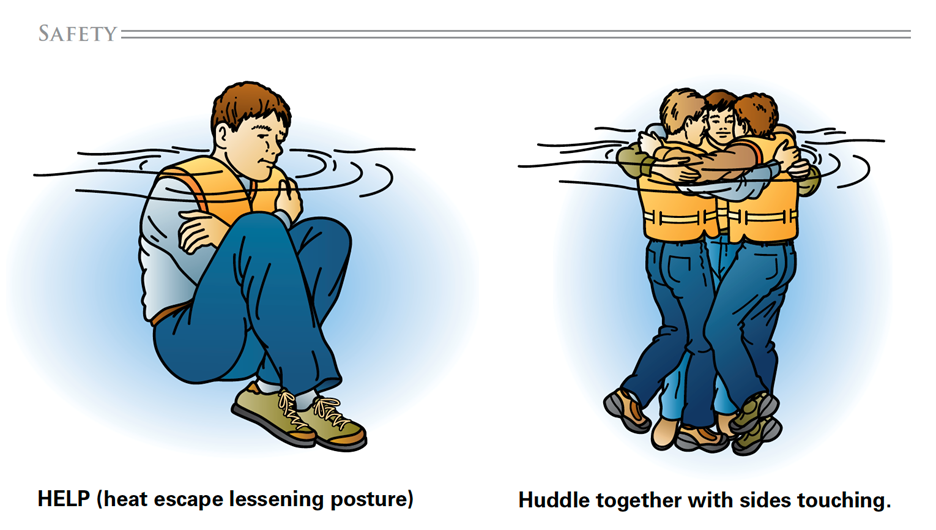
The longer you are in the water the greater risk of developing hypothermia. If you cannot self-rescue by getting your body out of the water you then must begin to prepare for the possibility of hypothermia. Hypothermia, is the decrease of your body’s core temperature. Many factors contribute to hypothermia and how fast it can happen. This includes the water temperature, how much of the body in immersed in the water and your own body’s size and condition. In cold water (water below 68F), most people will become hypothermic in 1 – 2 hours. So, if you haven’t been able to get yourself out of the water you need to think back to your Scout aquatics training (Swimming merit badge) to the H.E.L.P. position in cold water (Heat, Escape, Lessening, Position). That can make a big difference in slowing down the onset of hypothermia. This can only be effectively done if you have your lifejacket on so that’s another great reason to always wear your lifejacket when in a boat! If you are with one or more buddies the best thing to do is to get into a HUDDLE position where you crowd together to conserve body heat. This action also slows the onset of hypothermia.
Once you become hypothermic you will eventually lose consciousness. At that point you have around another hour or so until you may experience cardiac arrest. In all cases, when out on a hike or on the water you should always be certain your leaders must know where you are and when you are expected back. If you are late returning, they should begin to search for you to provide help.
So, remember, if you find yourself accidently immersed in cold water remember the 1 minute, 10 minute and 1 hour principle and: 1) Don’t Panic; 2) Keep you head above the water and try to control your breathing; 3) Make a plan for getting as much of your body as of the water as quickly as possible; 4) If you cannot get out of the water within 10 or so minutes assume the HELP position or if with buddies, then Huddle-UP to delay the onset of hypothermia. Always wear your lifejacket when in a boat and also always be sure your leaders know your plans when going on a hike or boating so if you are late returning, they can find you and give your help.
Camping
Join us in the heart of the rugged Southwest at Philmont for the 2025 National Outdoor Conference—the ultimate gathering for Scouters and outdoor enthusiasts! Whether you’re looking to level up your skills, get inspired by top speakers, or simply connect with like-minded adventurers, this biennial event is the place to be.
Where: 📍 Philmont Training Center, Cimarron, NM
When: 📅 September 17-21, 2025
🌟 Conference Highlights:
- Dynamic workshops and hands-on training to elevate your outdoor programs
- Inspiring keynotes from leaders in the outdoor industry
- Networking opportunities with Scouters and outdoor pros from across the country
- A firsthand look at the latest in gear, gadgets, and innovations
Don’t miss this chance to discover new ideas, sharpen your skills, and share in the excitement of the great outdoors with fellow Scouters. Stay tuned for updates on registration, class offerings, lodging, and more!
Be sure to sign up on the 2025 National Outdoor Conference website to receive email alerts—let the countdown to adventure begin!
NCAP
Hey Camp Leadership!
You know those post-camp and pre-camp inspections we go through every year? Well, they’re not just paperwork. They’re our golden ticket to making sure our camps are top-notch for the Scouts.
Post-camp/Pre-camp Inspection Checklists (430-310) stand as essential tools in ensuring the safety, functionality, and improvement of Scouting facilities (see NCAP Standard FA-701). They serve not only as a checklist for immediate repairs but also as an incredibly useful tool for making capital improvement decisions, laying the groundwork for enhancing the Scouting experience.
Think of it like this: these inspections aren’t just about checking off boxes. They’re like our roadmap for making strategic upgrades and improvements. And guess what? Getting some volunteers involved can turn these inspections into a real game-changer.
Let’s take a look at how we can make the most of these inspections:
Taking Stock: Let’s dive deep into how our camp performed last season. What worked? What needs fixing? From the state of our cabins to our safety protocols, let’s leave no stone unturned. Use the Pre-Camp/Post-Camp inspection form to help guide you through this discussion. The document is meant to help you take a strategic look at the property and the programs at your camp. It will help you plan any maintenance and upgrades or upkeep that camp needs to be ready to open.
Get Lots of People Involved: We’ve got some smart, dedicated people, on our council committees, right? Well, let’s put their heads together. By getting folks from facilities, finance, and program development on board, we can tap into a wealth of knowledge to figure out our next steps. Take them with you to camp and have them walk through the area with you as they will see things that you do not. Invite folks who have never been to camp as well as they will bring a fresh perspective on the walkthrough.
Use the Right Tools: Leverage Scouting America’s Camp Facility Evaluation tool as another tool in this inspection. It’s like our camp-improvement GPS. By using this tool, we’re gathering hard data to steer our decisions. No more flying blind—this tool helps us focus our efforts where they’ll have the biggest impact.
Now, onto the real work:
Spotting Opportunities: Armed with our inspection findings and committee input, it’s time to figure out our action plan. Whether it’s sprucing up our infrastructure or beefing up our safety measures, let’s pinpoint our targets.
Making a Game Plan: Let’s rally some volunteers and map out our strategy. With input from our committees, we’re setting priorities and deadlines. Budgets, timelines, you name it—we’re getting it all sorted. Collaborating with your committees and the council staff helps to build a plan that everyone can agree on and that meets the objectives of the council.
Putting Our Money Where Our Mouth Is: We’re working hand-in-hand with the finance committee to make sure the cash is flowing where it’s needed most. If we need to do a little fundraising to meet the need this team needs to be involved.
Keeping Tabs on Progress: We’ve got our plan locked in—now it’s all about execution. We’re keeping a close eye on things, making tweaks as needed, and celebrating wins along the way. Communicate to your units who are coming as you make these improvements or upgrades to keep the excitement going about the upcoming season.
In a nutshell, by teaming up for post-camp inspections and getting strategic with our planning, we’re setting ourselves up for success. Let’s keep the campfire burning bright!

Camping
As Scouting America continues to strengthen its outdoor experiences, leadership plays a vital role in shaping the programs and properties that inspire the next generation. We recently sat down with Scott Anderson the newly appointed Chair of the Outdoor Programs and Properties Committee, to learn more about his vision, priorities, and passion for the outdoors.
Q&A with Scott Anderson, Chair of the Outdoor Programs and Properties Committee
Q: What inspired you to take on this leadership role within Scouting America?
A: I am the product of a strong Scouting unit program, and I know firsthand the impact that great leadership and a strong outdoor program can have on young people. Scouting gave me opportunities to explore nature, challenge myself, and learn to lead, each of these experiences that shaped who I am today. Taking on this role is a way to give back and help ensure that every youth in Scouting America has the same opportunity to get outdoors, have fun, and develop confidence and leadership through real experiences.
Q: The Outdoor Programs and Properties Committee covers a wide range of responsibilities. How do you describe the mission of the committee?
A: Our mission is to support our councils and the variety of outdoor programs that Scouting uses to deliver its values-based leadership experience for youth, and to make sure those programs are delivered safely and sustainably across our properties. The committee brings together experienced volunteers and subject matter experts to help Scouting stay relevant, inspiring, and focused on developing young people of character and leadership.
Q: What are some of your top priorities for the coming year?
A: Our priorities align closely with Scouting America’s Roadmap. We’re focused on being a leader in safeguarding youth by ensuring all our outdoor programs and properties meet the highest standards of safety and quality. We also want to change the way we work together by simplifying and streamlining the National Camp Accreditation Program to remove barriers and better support councils. At the same time, we’re working to make our outdoor programs highly relevant to today’s youth, broaden our appeal through exciting and accessible experiences, and strengthen our financial position by helping councils use their properties more efficiently and sustainably.
Q: How does the committee support local councils?
A: We support councils by connecting them with resources, expertise, and best practices for delivering safe and effective outdoor programs. Whether it’s camp operations, aquatics, range and target activities, COPE, climbing, or property management, our subcommittees and subject matter experts work collaboratively to provide guidance, training, and tools that help councils strengthen their local programs and facilities.
Q: Outdoor programs continue to evolve. How do you see Scouting adapting to the interests of today’s youth?
A: Today’s youth are seeking adventure, relevance, and purpose. Scouting’s outdoor program is uniquely positioned to meet those needs by blending traditional outdoor skills with modern learning opportunities, including high-adventure activities, STEM integration, and outdoor leadership experiences. We’re also focusing on accessibility, ensuring that every youth, regardless of background, has the chance to experience the fun, challenge, and personal growth that come from being outdoors.
Q: What role do volunteers play in advancing the committee’s goals?
A: Volunteers are the backbone of this effort. Each subcommittee is led by dedicated Scouting volunteers with proven leadership and expertise in their fields. They work closely with subject matter experts to shape and deliver the best possible outdoor experiences. Our volunteers make it possible to translate national vision into local impact ensuring that every youth member benefits from safe, meaningful, and fun outdoor adventures.
Q: What excites you most about the future of outdoor programs and properties in Scouting America?
A: What excites me most is the potential to reimagine the outdoor experience for a new generation. We have an opportunity to make Scouting’s outdoor programs more accessible, more innovative, and more connected to what motivates youth today. By investing in our properties and expanding program options, we can ensure that the outdoors remains the foundation for leadership development and lifelong learning in Scouting America.
Q: How can others get involved or support the work of the committee?
A: There are many ways to get involved – from serving on a council or district committee, to becoming a Short-Term Camp Administrator, a Distinguished Conservation Service Award advisor, or part of an NCAP Area Camp Assessment Team. Professionals and educators can also share their expertise in areas like safety, sustainability, and program design. Most importantly, everyone can help by getting Scouts outdoors! Every hike, campout, and service project helps build young people who care about their world and can go on to lead lives of impact and purpose.
Closing Thoughts
As Scott takes on the role of Chair, it’s clear that the future of Scouting America’s outdoor programs and properties is in capable hands. His leadership brings a renewed focus on innovation, sustainability, and collaboration which will ensure that every Scout has a place to explore, learn, and grow.
Safety
As camp leaders, it’s imperative to recognize the growing mental health challenges faced by young adults, particularly those aged 18 to 25 – the demographic that comprises a significant portion of our camp staff. Recent data from the JED Foundation indicates that 36.2% of individuals in this age group have experienced a mental, behavioral, or emotional health issue in the past year, a notable increase from previous years.
In response to this pressing concern, Scouting America’s health and safety team, working alongside the Outdoor Programs team, has developed Mental, Emotional, and Social Health (MESH) training materials for camp staff. These resources are specifically designed to equip camp staff with the knowledge and skills necessary to support both peers and campers effectively within their skillset. The training teaches the U-S-A Model to help our staff Understand the behaviors to watch for, Speak to Scouts and provide Support and to Act and Advocate for Scouts. The session is written so that it is easily delivered by the Camp Director or Camp Program Director or Health Officer.
Implementing this training may be a part of your plan to meet the National Camp Accreditation Program (NCAP) standard RP-551, which emphasizes the importance of council committees providing support to camp staff.
You can find these materials on the Camp Director Resource Page. By integrating this training into your staff development programs, you not only enhance the well-being of your team but also foster a safer, more supportive environment for all camp participants.
Prioritizing mental health is an important part of our support of Scouts and staff. By proactively addressing these challenges through dedicated training and support, we can make a profound difference in the lives of those we serve.
National Jamboree
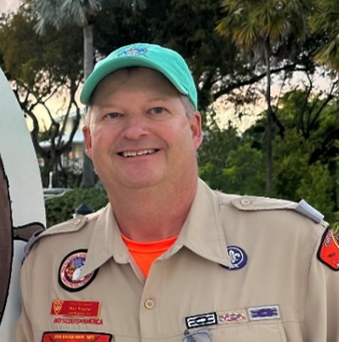
We are thrilled to announce the selection of Michael “Mike” Prachar as a Senior Program Administrative Specialist within the Outdoor Programs and Properties department beginning July 1, 2024. In this role, Mike will serve as the Associate Director of the National Jamboree.
As Associate Director of the National Jamboree, Mike will bring his expertise to support the development, administration, and management of a successful National Jamboree. In addition to his work with the National Jamboree, Mike will work alongside several national outdoor programs and properties subcommittees to support their efforts in delivering safe and impactful outdoor programs to youth across the nation.
Mike began his Scouting career in the Mecklenburg County Council as a district executive, and has since served as a district director, field director, Assistant Scout Executive, and Director of Support Services throughout Scouting including councils in North Carolina, South Carolina, and Maryland. Most recently, Mike has served as the Director of Support Services in the Circle Ten Council in Dallas Texas managing the council’s outdoor programs and properties extensive camping operations.
With Mike’s history of excelling under leadership in various councils and managing various teams, we are confident in his ability to make significant contributions to the success of the National Jamboree and other assigned opportunities within the Outdoor Programs and Properties department. His dedication to empowering volunteers and staff to create dynamic Scouting programs aligns perfectly with our mission and values.
Please join us in extending a warm welcome to Mike Prachar. We look forward to his contributions and collaboration as we continue to serve our Scouting community with excellence.
Aquatics
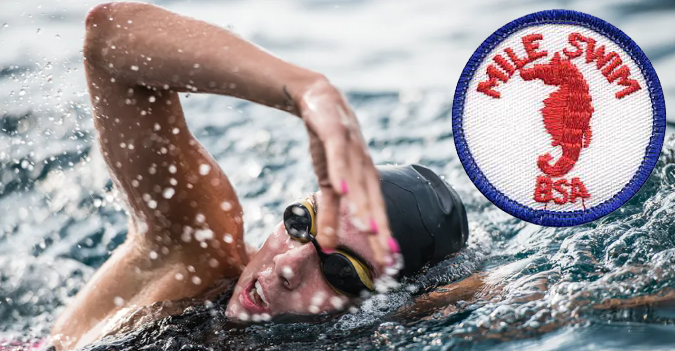
The Mile Swim Scouting America award was introduced in 1961 by Scouting America’s Health and Safety Service. The original purpose of the award was for Scouts to learn to swim a mile safely with ease. It was, and remains, a challenging recognition that contributes to fitness and safety. The last time the award requirements were updated was in 1981 when the purpose shifted from a worthwhile accomplishment promoting both safety and physical fitness to “encourage the development of physical fitness by introducing the youth to swimming as regular exercise.” Four hours of required training before swimming the mile was added as a requirement.
Drawing from feedback gathered from Scouting America Aquatics personnel at camps nationwide, the revised Mile Swim Scouting America award is refocusing on enhancing swimming stroke effectiveness and efficiency, particularly for individuals seeking improvement. Most Scouts who can walk or bike on level ground for an hour or so without stopping will likely have enough stamina to swim a mile and there are numerous other Scouts BSA programs that promote and develop regular exercise. The Mile Swim Scouting America award purpose is to build confidence and improve water competency.
UPDATED SCOUTING AMERICA Mile Swim Award Requirements:
- Successfully complete Scouting America’s swimmer test: Jump feetfirst into water over the head in depth, level off, and begin swimming. Swim 75 yards in a strong manner using one or more of the following strokes: sidestroke, breaststroke, trudgen, or crawl; then swim 25 yards using an easy, resting backstroke. The 100 yards must be completed in one swim without stops and must include at least one sharp turn.
- Learn through discussion and application how skill, stamina, stroke selection, and pace influence distance swimming.
- Pre-qualify for the mile by either swimming continuously for ¼ mile or otherwise demonstrating ability to the satisfaction of a counselor approved by the local council.
- Swim one mile under safe conditions over a course approved by the counselor supervising the swim.
Program Implementation
The revised Mile Swim Scouting America requirements are effective immediately (Spring/Summer 2024). It is recognized that many Scouting America camps will already have planned their camp summer aquatics program. Those camps may continue to present the previous (1981) version of the award program; however, all Scouting America Camps and Mile Swim Scouting America Counselors should plan on implementing the new Mile Swim Scouting America requirements for their 2025 programs. The Scouts BSA Mile Swim Emblem (SKU 245) and the Mile Swim Pocket Certificate (SKU 34394) remain unchanged. These recognition items are available at scoutshop.org. Award application and support materials can be found in the 2024 version of Scouting America Aquatics Supervision No. 34346
The Mile Swim Scouting America aquatics award is the ultimate recognition of Scouts and Leaders swimming prowess. It is hoped that this revised version of the award will encourage more Scouting America members to take the plunge and achieve this award.
Biking
May has rolled in and with it – National Bike Month, a time to celebrate the benefits of cycling. This presents a fantastic opportunity to engage Scouts in activities that promote health, environmental consciousness, and community involvement. Here are seven initiatives councils or units may undertake during National Bike Month:
Organize Bike Safety Workshops: Safety should always come first. Packs, troops, and crews can arrange workshops focusing on bike safety, covering topics like helmet usage, proper signaling, and road awareness. Collaborating with local biking organizations or police departments can enhance the credibility and effectiveness of these workshops.
Trail Maintenance Projects: National Bike Month is an excellent occasion to give back to the community. Units can coordinate trail maintenance projects, ensuring that biking trails are safe and enjoyable for all users. This not only fosters a sense of civic duty but also promotes environmental stewardship among Scouts.
Scenic Bike Rides: Explore the beauty of nature while promoting physical activity by organizing scenic bike rides. Whether it’s through local parks or along picturesque trails, these rides can be both recreational and educational, offering Scouts the chance to appreciate the outdoors while learning about conservation efforts in their area.
Cycling Merit Badge Clinics: National Bike Month provides an ideal backdrop for councils to host merit badge clinics focused on cycling. These clinics can cover the requirements for the Cycling merit badge, offering Scouts the opportunity to develop their biking skills under the guidance of experienced instructors.
Bike Safety Demonstrations: Coordinate interactive bike safety demonstrations at local schools or community events. Scouts can showcase proper biking techniques, emphasize the importance of safety gear, and engage participants in hands-on activities that promote safe cycling practices.
Environmental Awareness Campaigns: Use National Bike Month as a platform to raise awareness about environmental issues related to transportation. Councils can organize campaigns highlighting the ecological benefits of cycling, such as reduced carbon emissions and decreased traffic congestion, inspiring Scouts and community members to choose sustainable modes of transportation.
Family Bike Rodeos: Cub Scout packs can host family-friendly bike rodeos featuring skill-building activities and fun challenges for both Scouts and their families. These events can include obstacle courses, slow races, and bike decorating contests, encouraging families to bond over shared outdoor experiences while promoting biking as a healthy and enjoyable activity. The newly updated Cub Scout program launching on June 1, 2024 also includes a cycling related elective adventure for every rank!
National Bike Month offers councils & units a wealth of opportunities to engage Scouts in meaningful activities that promote health, safety, environmental awareness, and community involvement. By embracing initiatives like bike safety workshops, trail maintenance projects, and family bike rodeos, you can empower Scouts to become responsible cyclists and active stewards of their communities. Let’s pedal into National Bike Month with a commitment to promoting the joys of biking for Scouts and communities alike.
Email blast!
Email blast!