

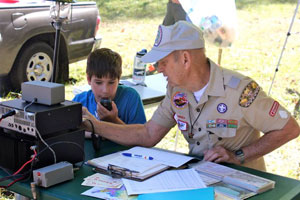
This is a chance for Cub Scouts, Boy Scouts, and Venturers to take part in an international jamboree and be introduced to technology that could serve to launch a lifelong hobby or even a career.
Note that radio amateurs spend a lot of time and effort working to achieve their licenses. In addition, they invest a great deal of money in their equipment and stations. Many are so passionately interested in their hobby that they cannot understand that to others it may be incomprehensible or even boring. It sometimes requires the skills of a diplomatic Scout leader to explain this to a keen ham who has given up his or her whole weekend to help with JOTA.
General Guidelines
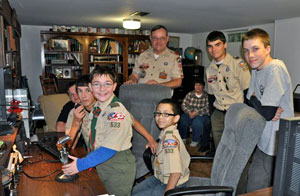 Here’s a few guidelines to follow as you prepare for the event:
- Make contact with local radio amateurs well in advance and discuss a balanced program of activities before and during JOTA.
- Make sure the amateur’s efforts are rewarded by ensuring that Scouts turn up for the event. Build up the event through publicity within your council, district, and unit.
- JOTA is a Scout event, and as such, Scout leaders are in charge. Keep firm control over those attending.
- Don’t assume that all radio amateurs are expert communicators with youth.
- Integrating events around JOTA can be very helpful in maximizing attendance. For example, set up a JOTA station (or several) at a camporee.
- Order participant patches for the number you expect to attend. Include some patches to share with the radio amateurs.
- Download the certificate of participation and log sheet. Duplicate enough for all participants.
- Review the section titled “Amateur Radio Terms.”
- Feed the radio amateurs on the day of the event.
- Thank the radio amateurs for their assistance.
- Register your event beforehand by sending an email with the location, a description of activities, the station call sign, and the expected number of participants to the national JOTA organizer at jota@scouting.org. The full report format is provided on this website. Check this site often to see a list of all the stations that have registered. You may find an opportunity to schedule a ham radio contact during the JOTA weekend.
- File a report of your station’s activities using the format on this site under the tab “JOTA Event Report Form.” When you return your event report, your event will be included, in summary form, in the full U.S. report submitted to the World Scout Bureau. You will receive a copy of the full report by email.
Radio Merit Badge Requirements Met by JOTA Participation
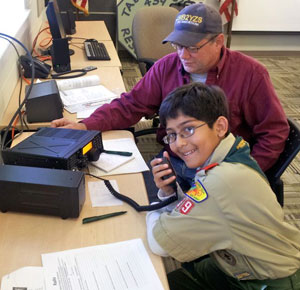 The following requirements can be completed during a typical JOTA event.
7) Visit a radio installation (an amateur radio station, broadcast station, or public communications center, for example) approved in advance by your counselor. Discuss what types of equipment you saw in use, how it was used, what types of licenses are required to operate and maintain the equipment, and the purpose of the station.
9a(6) Using proper call signs, Q signals, and abbreviations, carry on a 10-minute real or simulated radio contact using voice, Morse code, or digital mode. . . . Properly log the real or simulated ham radio contact and record the signal report.
Publicity
You’re encouraged to send news releases of the event to all local newspapers and television and radio stations. You can encourage photographers to attend the event. You can also forward photos to your local news media, including weekly papers. A sample news release is included on this website.
Final Thoughts
It’s recommended that you also look over the “Guidelines for Amateur Radio Operators.” While the technical terms may be challenging, it will give you an idea of the necessary preparation by your partners in the event, and perhaps you’ll see areas where you can help.
Best wishes for a great Jamboree-on-the-Air. We look forward to hearing all about it in your JOTA report.
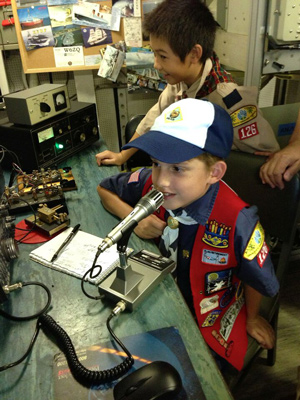
Successful Jamboree-on-the-Air stations need three key ingredients:
- They need licensed radio amateurs who understand what Jamboree-on-the-Air is trying to achieve and who can work with youth in radio operations and in demonstrating/explaining the technology in use.
- They need Scout leaders who want to offer their Scouts an opportunity to take an active part in international Scouting and technology activities.
- They need a sound partnership between the radio amateurs and the Scout leaders.
The partnership is important because although the radio amateurs have the technical resources and skills, they may well need help in working with young people. Likewise, the Scout leaders can rely on the expertise and experience of the radio amateurs to present all aspects of amateur radio accurately and with enthusiasm. They will also ensure that the station is operated in accordance with all regulations and standard operating practices.
The Scout leader’s role is to help prepare the participants for JOTA, getting them there on the day(s), and possibly looking after other arrangements. Finding a licensed radio amateur shouldn’t be too difficult. You can contact a local ham radio operator or a local amateur radio club. You can find a searchable database of clubs at www.arrl.org/find-a-club. This website is operated by the American Radio Relay League, the national association for amateur radio, which is cooperating closely with Scouting America on JOTA and many other activities.
Your local club may be able to direct you to its planned JOTA activities. These can include ham stations set up at camporees or other events. Or, if there are no planned activities, you can either work with them to get something set up or arrange to visit a local radio operator’s ham shack at a scheduled time to participate in JOTA.
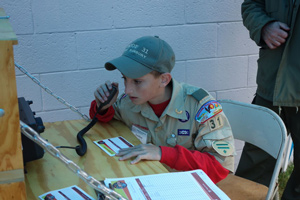
Early preparation and planning are important to make sure all aspects of the JOTA event come off smoothly. You wouldn’t want to disappoint the Scouts or damage the relationship between amateur radio operators and Scouting. A sample planning calendar is included on this website at the link to the right on this page. We’ve also provided examples of JOTA planning documents at https://www.k2bsa.net/jota-station-planning/.
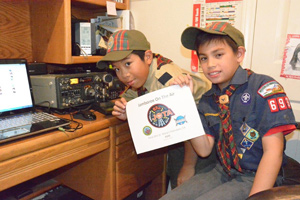 The types of activities during JOTA as well as leading up to and after the event are limited only by your imagination. Here are a few thought starters. You can also find more planning tips at https://k2bsa.net/jota-event-tips/.
Before JOTA
- Ask an amateur radio operator to talk about ham radio communications. In patrols, visit his station to see how it works. Learn about radio waves and their propagation.
- Design special QSL cards with Scouting themes for the JOTA weekend. QSL cards are exchanged with the other stations and Scouts you contact during JOTA.
- Find an unusual location for the JOTA station, working closely with your amateur radio partner.
- Find out about commercial radio and television. How are programs made? Visit a television or radio station. How are programs transmitted? How does a radio receiver work? Build a radio receiver.
- Learn about electricity. How is it produced? Learn about safety procedures. Visit an electricity generating station.
- Learn and practice using Morse code. Build a Morse code practice oscillator.
- Find out about other countries and prepare questions to ask over the air.
- Practice talking into a microphone using radio operating procedures and terminology.
- Find out about your local area to be able to answer questions from Scouts in other countries and other parts of the U.S.
- Send a report of your plan to the local newspaper. Ask them to visit during the event.
- Learn a few words of greeting in other languages.
During JOTA
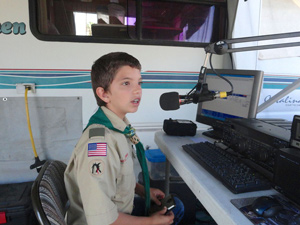
 Arrange a weekend camp or camporee and set up the station at the site.
- Arrange a program of camp activities to run concurrently.
- Invite parents and other supporters to visit the station to see what the Scouts are doing.
- Organize a weekend hike and take portable radio equipment. Log the contacts made for the amateur radio operator.
- Ask each Scout to prepare his own personal logbook. Include details of the names of the Scouts contacted, the frequency, the station call sign, and the mode of operation.
- Set up an information section that can quickly find out a few details about the location of the station you’re in contact with, including the country or state.
- Plot contacts made on a world map or a U.S. map.
- Complete QSL cards to send to the people contacted.
- Make a tape recording of the conversations.
- Build simple electronic kits.
- Prepare and publish a JOTA newsletter or a story for your troop, district, and council newsletters or websites.
- Prepare a quiz and ask the questions over the air.
- Complete participation cards for each Scout who talked. Use the certificate/log forms that can be downloaded from this site.
- Determine the distance between each radio station and your station.
After JOTA
- Write the Scouts contacted. Send QSL cards and/or a patch.
- Start planning to participate again next year.
- File your report and photos with the national JOTA coordinator using the online system published on this website.
We’ve also prepared a Troop Meeting Plan, which you can find at https://k2bsa.net/troop-meeting-plan-radio/ along with a Cub Scout Program Helps at https://k2bsa.net/cub-scout-program-helps-jota/