NOT ALL WHO wander are lost. But some are. SearchandRescueMB
From 1992 to 2007, for example, the National Park Service averaged 11.2 search-and-rescue (SAR) incidents per day. And you don’t have to be in a remote national park to get lost. According to the Alzheimer’s Association, up to 60 percent of dementia patients will wander away from care at some point during their illness. Even Scouts occasionally lose their way — though some might echo Daniel Boone, who said, “I have never been lost, but I will admit to being confused for several weeks.”
Assisting the lost and confused is the aim of the Search and Rescue merit badge, one of the newest merit badges. Developed by SAR professionals and Philmont Scout Ranch veterans, the badge shows Scouts how to find search subjects, bring them to safety and avoid becoming lost themselves.
To learn more, we caught up with Doug Palmer, Philmont’s retired associate director of program, and Gary Williams, a New Mexico-based Scouter and SAR volunteer who got his start in SAR nearly 50 years ago as an Explorer Scout.
How capable are Scouts who have completed this badge? Like other merit badges, Search and Rescue offers an introduction to the topic, not in-depth training or certification. “This is not something where, when they complete this merit badge, they’re going to be able to immediately go out and do search and rescue,” Williams says. “The idea is to give them a good intro and whet their appetite.”
Scouts who are interested in going further could check into the Civil Air Patrol, whose cadet program involves kids from ages 12 through 18. Older Scouts might also be able to join local SAR teams, though age limits and training requirements vary.
Speaking of ages, is this badge better for older Scouts? “I think older Venture-age Scouts would do better,” Williams says, referring to Scouts 13 or 14 and up. “It requires a level of maturity that you don’t really see in a younger Scout.”
Palmer agrees but points out that every Scout is different. “You can have an 11-year-old that could understand it fine,” he says. “It depends on the kids.”
The requirements talk about the Incident Command System. What is that? “ICS is a system of managing any kind of emergency from a very small emergency to something as big as a hurricane,” Palmer says. “It starts with an incident commander, and then that person has various staff members that report to him or her.”
Requirement 5 talks about completing ICS-100 training. Explain that. “We’re asking them to take one of the courses on the website to become familiar with it,” Palmer says. “We just want the kids to do that first one, which covers all the terminology and the reasons the ICS exists.”
The required course, ICS-100, takes about three hours to complete. It can be found at http://training.fema.gov/EMIWeb/IS/IS100b.asp.
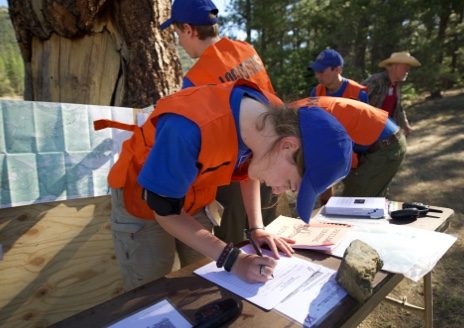
The badge culminates in a practice search. How would you set that up? “You would have a hypothetical subject, you would have a point last seen, and you would have a missing person report filled out,” Palmer says. “Then the Scout who’s managing the search would assign teams to certain tasks. You would probably put some bogus clues out there, and the Scouts would find the clues and report them back to the incident base. The incident base would determine if they’re valid clues that might have been left by the subject.”
And how do you keep your searchers from becoming subjects? Williams cites the practice searches he has led in Albuquerque’s Elena Gallegos Park. He would tell searchers to stop at the wilderness gate if they hadn’t found the subject. “That enabled us to control the area and still give them a challenge in terms of whom they were looking for,” he says.
Talk about what researchers have learned about subject tendencies. “Different outdoor users have different characteristics,” Palmer says. “For example, hunters tend to be pretty focused on where they are. A backpacker’s pretty focused because he has a destination in mind. Typically Scouts are trained to stay put. Of course, they don’t always do that. There are more and more Alzheimer’s patients who are becoming missing. They’re really difficult to find, because they don’t often do predictable things.”
How has technology changed search and rescue? “There are a lot fewer searches than there used to be because of cellphones and GPS and SPOT locator beacons; there are a lot more rescues than there are searches,” Palmer says. “But it’s serious business. If a person is missing, somebody’s worried about them.”
How can Search and Rescue merit badge counselors really bring the topic to life? “Taking a tour of [a SAR base] would be great,” Williams says. “Scouts could actually see the device for lowering rescuers from a helicopter … having it actually hooked up to the winch on the aircraft.”
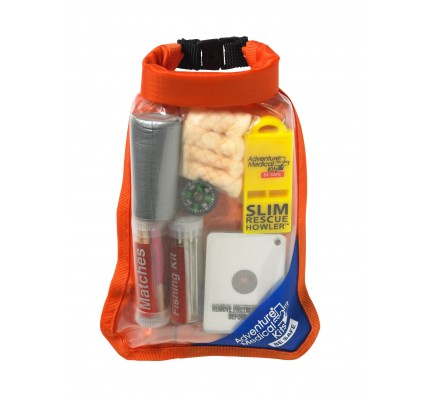
Requirement 2 is all about staying found and avoiding becoming a SAR subject. What’s the key lesson? “Nearly every time a person goes missing, if you go back and debrief that person after they’re found, you can nearly always determine that there were one or two decisions that person made early on that predicated the problem,” Palmer says. “It’s all about good decision-making in the out-of-doors and, like the Scouts say, being prepared.”