
Scouting America

Range Supervision and Your Unit – What You Need to Know

Range & Target Activities

Range Supervision and Your Unit – What You Need to Know

2026 March - April Edition

Range & Target Activities

Range Supervision and Your Unit – What You Need to Know
2026 March - April Edition
Screenshot 2026-03-11 113155

Your unit wants to conduct a Range and Target Activity…How can you help them prepare? 

To begin with we need to ensure the unit is allowed to do the activity. For that we check Scouting America’s Age-Appropriate Guidelines for Scouting Activities, pub. 680-685. Under the “Range & Target Activities” section, the various range activities are listed and check marks are placed in the columns for the program areas that are allowed to do them. Let’s look at the row for “.22 bolt action rifle”. The chart shows us this activity is only allowed for Scouts BSA, Older Scouts BSA, Sea Scouts and Venturers. 

Program Lions Tigers Wolf/Bear Scouts Webelos Arrow of Light Scouts BSA Older Scouts BSA, Sea Scouts, Venturers
.22 Bolt Action Rifle          

(Age Appropriate Guidelines for Scouting Activities may be found here https://filestore.scouting.org/filestore/HealthSafety/pdf/680-685.pdf ) 

Similar to water sports and COPE & climbing which have Safe Swim Defense, Safety Afloat, and Climb on Safely all Scouts BSA troops, Venturing crews, and Sea Scout ships who provide unit-level sponsored/planned range and target activities must have at least one registered unit leader 21+ years of age take the Range Activities SAFEty online training available onmy.scouting.org. This individual must be present at the range during the range and target activity(s). Participating in this training will help ensure a unit understands Scouting America’s range and target activities policies.  The training is available not only to our leaders, but parents as well.  We recommend everyone take the training to understand the safety protocols that are to be in place anytime we are at the range. 

Once we determine the activity is permitted for our group, we would look at Scouting America’s SAFE checklist.   (https://stg.scouting.org/health-and-safety/safe/) 

For the purposes of this article, we are going to focus on the ‘S’ in SAFE. 

S stands for Supervision: Youth must be supervised by qualified adults who prioritize safety. 

Supervision requirements for range and target activities can be found in Scouting America’s Range and Target Activities manual, #430-938, pages 9-13. These pages contain charts showing the various requirements necessary to conduct a SAFE range activity. (Manual may be found at https://stg.scouting.org/wp-content/uploads/2025/12/430-93825b-Range-and-Target-Activities-Manual-FINAL.pdf) 

Let’s review the chart for the .22 bolt action rifle for a Scout unit activity. 

Program Participants Safety Equipment Minimum program supervision requirements Qualified staff to open the range Minimum number of staff to operate RSO: participant and instructor: participant ratios Additional information
Rifle (Unit Activity) Scouts BSA, Venturing, Sea Scouting Eye and hearing protection NRA Rifle Instructor
AND
NRA Range Safety
Officer
National Camping School Range Activities Director
NRA Rifle Instructor
AND NRA Range Safety Officer

2 people (RSO
and at least one
instructor)

1:8  

Program – Rifle (Unit activity) 

Participants – Scouts BSA, Venturing, Sea Scouts 

Safety Equipment – Eye and hearing protection 

Minimum number of staff to operate – NRA Rifle Instructor AND NRA Range Safety Officer 

Qualified staff to open the range – National Camping School Range Activities Director, NRA Rifle Instructor AND NRA Range Safety Officer 

Minimum number of staff to operate – 2 people (RSO and at least one instructor) 

RSO to Participant and Instructor to Participant ratios – 1:8 

Additional Information – none  

As can be seen, this chart provides a lot of information regarding what is required for a .22 bolt action rifle activity at the unit level.  

We have used the .22 bolt action rifle activity as our example, however the charts on pages 9-13 include the supervision requirements for any activity related to range and target sports at all levels of the program. 

A quick overview of supervision requirements: 

Archery: USA Archery Level 1 (or higher) instructor  

Tomahawk/Knife Throwing: As set in the standard operating procedures of the council 

Atlatl: As set in the standard operating procedures of the council 

Catapult: NRA Range Safety Officer 

Chalk Ball: NRA Range Safety Officer 

BB gun: Scouting America BB gun rangemaster OR NRA rifle instructor 

Pellet gun: NRA rifle instructor  

.22 bolt action rifle: NRA rifle instructor AND NRA range safety officer 

Muzzle loading rifle: NRA CO-OP ML rifle instructor OR NRA ML instructor AND NRA range safety officer 

Shotgun: NRA shotgun instructor AND NRA range safety officer 

Muzzle loading shotgun: NRA CO-OP ML shotgun instructor OR NRA ML instructor AND NRA range safety officer 

The Range and Target Activities manual exists to provide the needed information at the unit, district, council or national levels when planning a range or target activity.  You should always refer to the manual for program guidance.  For information about conducting Range and Target Activities at a camp, please refer to the NCAP standards in addition to the Range and Target Activities Manual.  

Our goal for all Scouting Range and Target Activities is that they are safe and well supervised. The correct supervision will help ensure a safe, fun ‘on target’ event for our participants.   

If you have questions about Range and Target programs, please reach out to us at shootingsports@scouting.org  

See the rest of the articles from the 
2026 March - April edition
See the rest of the articles from the 
2026 March - April edition

Related

Other Range & Target Activitiesarticles

Shooting-Sports-Rifle

Range & Target Activities

The Range and Target Activities (Shooting Sports) currently offered by Scouting America are highly complex, requiring knowledgeable supervision, qualified instruction, and strict adherence to standard operating procedures. The following Q&A reviews upcoming September 1st program adjustments that aim to simplify these programs while ensuring safety standards are met. Prior to reviewing these FAQs, please review the upcoming changes listed HERE in the Guide to Safe Scouting. 

Q: Why are range and target activities (shooting sports) part of Scouting’s programs? 

A: Range and target activities provide Scouting the opportunity to instruct critical safe firearm handling to all age groups while also providing an opportunity for a Scout to learn self-discipline, concentration, mental discipline, self-reliance, self-esteem, problem-solving and responsibility. Teaching safe firearm handling includes conversations such as “What happens when you see a gun? Never touch the gun, leave it where it is, and tell an adult right away.” Scouting is committed to teaching youth how to be safe around firearms, whether at home, in their neighborhoods, or around the community. 

Q: Why is Scouting updating its range and target activities (shooting sports programs) effective 9/1/2024? 

A: With a focus on safety and delivery of a quality program, these program adjustments aim to simplify and further standardize range and target activities, thus enhancing the overall experience for Scouts and Scouters alike. 

Q: Why is the name of shooting sports programs changing to Range & Target Activities? 

A: This new name reflects both where these activities take place (on established ranges) and what these activities are. 

Q: Starting in September, besides a nationally authorized camp property’s range, Scouts can participate in firearms programs on a commercial range. How will Scouting America define a commercial firearm range? 

A: A commercial firearm range is a supervised facility that offers a controlled environment for safe firearm practice. It will provide shooting lanes, targets, and may offer equipment rentals and training in safe firearm handling and marksmanship. Standard operating procedures are required for each firearm type used on-site.  Scouting’s range and target activities must follow all of Scouting’s range and target activities policies or range standard operating procedures that are equivalently stringent, including no variation from Scouting’s limitations on firearms used. These ranges may be operated by a licensed business, a government entity or non-profit. 

Q: And also, what is a nationally authorized camp property? 

A: A national authorized camp property is defined by the National Camp Accreditation Program standards in SA-001. This definition is “A camp property includes any property over which a Scouting America council exercises long-term control that is made available to Scouting America units or individuals for use in Scouting America branded program activities.”  For full information on what is a nationally authorized camp property, please review the entire NCAP standard SA-001. 

Q: My Scouts BSA troop wants to conduct a weekend activity focused on the Rifle Shooting merit badge, can we still host this event after September 1, 2024? 

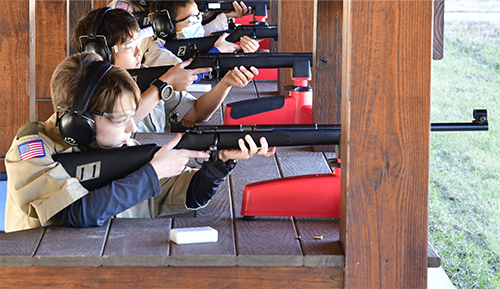
A: Yes. Scouts BSA troops can offer these activities with the required supervision certifications indicated in Scouting America’s Shooting Sports Manual at either a nationally authorized camp property range(s) or at a commercial firearm range. Reminder- your unit must also have someone who has completed the online Range Activity SAFEty training. This trained adult leader must be present at the range. Note this training does not replace the requirements for certified NRA firearms instructors and range safety officers. This training will be available beginning 9/1/2024. 

Q: There is a new Range Activity SAFEty training?? 

A: Yes. On September 1, 2024 this training will be available for unit leaders to take on My.Scouting (the same place you can take Youth Protection training online etc). Less than 40 minutes, this online training will help Scout leaders be prepared to successfully offer these programs at the unit level. 

Q: Our Venturing crew is interested in participating in a pistol program. Is it still possible for us to do so? 

A: Yes, Venturing crews participate in the NRA FIRST Steps Pistol Orientation at an accredited camp program (day camp, short-term camp, long-term camp) or a council organized one day event. Reminder, effective 9/1/2024, unit-level sponsored/planned Venturing and Sea Scouting pistol programs are prohibited. This program will also be available for older Scouts BSA youth.

Q: How does Scouting define “firearm”? 

A: Firearms include pellet rifles, airsoft (any type), rifles, pistols, shotguns, and muzzle loading rifles and shotguns. While Scouting does not define a BB gun or “BB device” as a firearm, some states, counties, or jurisdictions may regulate BB guns as firearms, depending on their design and capabilities. Councils must review and follow any local regulations before conducting programs. 


If planning an upcoming event or outing for your unit or council involving range & target activities, please remember to visit Scouting.org on September 1st to review the new National Range & Target Activities Manual and any revisions to the Guide to Safe Scouting.   

Still have questions?  We invite you to watch a recording of our Range and Target Activities Program Updates (a Venturing focus but all levels are reviewed) webinar that premiered on July 10.  You may also attend an additional, Outdoor Program & Properties Team sponsored, webinar on August 15th.  The links for both the recording and to register for the upcoming webinar may be found below.   

Resources: 

  • Range & Target Activities Program Updates Discussion and Q&A Registration Link (August 15th Live Webinar) 
    https://scouting-org.zoom.us/meeting/register/tZEqce2orDotHN378fJ0lxBhit6kJGubesBC 
Rata Manual

Range & Target Activities

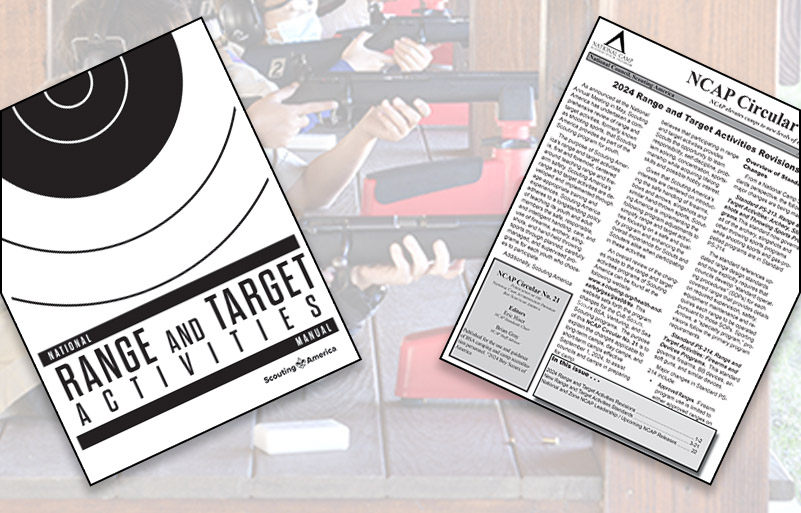
The 2024 National Range & Target Activities Manual is now available for download on Scouting.org.  This document replaces all previous versions of the National Shooting Sports Manual and has a revision date of September 1st, 2024.  Reminder, the Guide to Safe Scouting states that any range & target activities not detailed in our program literature or the National Range & Target Activities Manual are prohibited.  

In other range & target activities related news, National Camp Accreditation Program Circular 21 was released on August 26th.  This is where you can read about changes to the following three standards:

  • PS-213 (RANGE AND TARGET ACTIVITIES: ARCHERY, SLINGSHOTS, AND THROWING SPORTS PROGRAMS)
  • PS-214 (RANGE AND TARGET ACTIVITIES: FIREARMS AND DEVICES PROGRAMS)
  • SQ-407 (RANGE AND TARGET ACTIVITIES PROGRAM STAFF)

These standards changes went into effect on September 1st, 2024.

If you have involvement in range & target related activities (at any level in Scouting), please take time to download and review these two very important documents and share them with others in Scouting who may need this important information.

pumpkins

Camping / Range & Target Activities / Safety / Shooting Sports

Fall is also one of the best seasons to be outdoors in Scouting. The mornings are crisp, the afternoons are perfect for a hike, and the woods are showing their “true colors” as the leaves change. Around Scouting America, leaders and youth are pulling out the flannel shirts, unrolling sleeping bags, and heading into the beauty of fall for camping trips, service projects, and fun seasonal activities. 

Fall is one of the most popular seasons for Scout Camping.  

Cooler weather makes campfires more inviting, hikes more enjoyable, and sleeping outdoors beneath the stars a bit more tolerable (ever slept outside in July in Texas?). Lots of units take advantage of the cooler weather to enjoy outdoor activities like:  

  • Weekend campouts with Dutch oven cooking or cooking over a fire 
  • Fall service projects like trail cleanup or park beautification 
  • Orienteering challenges in leaf-strewn forests 
  • Harvest-themed campfires and fellowship gatherings 

And while fall enjoyment is the goal, safety always at the top of Scouting’s agenda goes along with it. 

The Temptation of “Pumpkin Chunkin” – And Why It’s Prohibited 

It’s hard to imagine fall without pumpkins –  pies, jack-o’-lanterns. Certain groups have been tempted in recent years to add “pumpkin chunkin” to their camp activities. If you are not familiar this is using catapults, trebuchets, or air cannons to shoot the pumpkins in the air. 

It might look like harmless fun, but in Scouting America, it’s on the list of prohibited activities. The Guide to Safe Scouting prohibits the launching of pumpkins or other objects with tools such as air cannons or trebuchets because of the inherent danger posed by such activity. Hazards include: 

  • High-velocity projectiles that can injure people or damage property 
  • Unstable homemade launching devices that can collapse or misfire 
  • Inconsistent projectile paths that make safety zones difficult to control 

If it’s on the Guide to Safe Scouting “prohibited activities” list, it’s out – no exceptions. The idea isn’t to ruin the fun but to make sure everyone has fun without getting hurt while doing it. 

Safe and Fun Fall Options 

If you prefer a pumpkin activity that still brings the essence of the season, try: 

  • Pumpkin decorating contests (paint, markers, and creativity encouraged!) 
  • Pumpkin bowling with lightweight plastic pumpkins and pins – Cub Scouts vs parents makes this a hit.  
  • Pumpkin relay races (carrying, or rolling, not tossing!) 
  • Cooking pumpkin treats in a Dutch oven at camp 

These exercises keep the focus on fun, teamwork, and seasonal spirit while still falling within Scouting America guidelines.  

Enjoying the Season the Scouting Way 

As leaves crunch and campfires crackle, remember that in Scouting America, adventure and safety go hand-in-hand. And with the Guide to Safe Scouting, leaders have it so everyone can head home with great memories and unscathed. 

So don your fleece, stock your marshmallows and graham crakers, and get outside this fall. The weather is crisp, the trails are calling, and the adventures are waiting. 

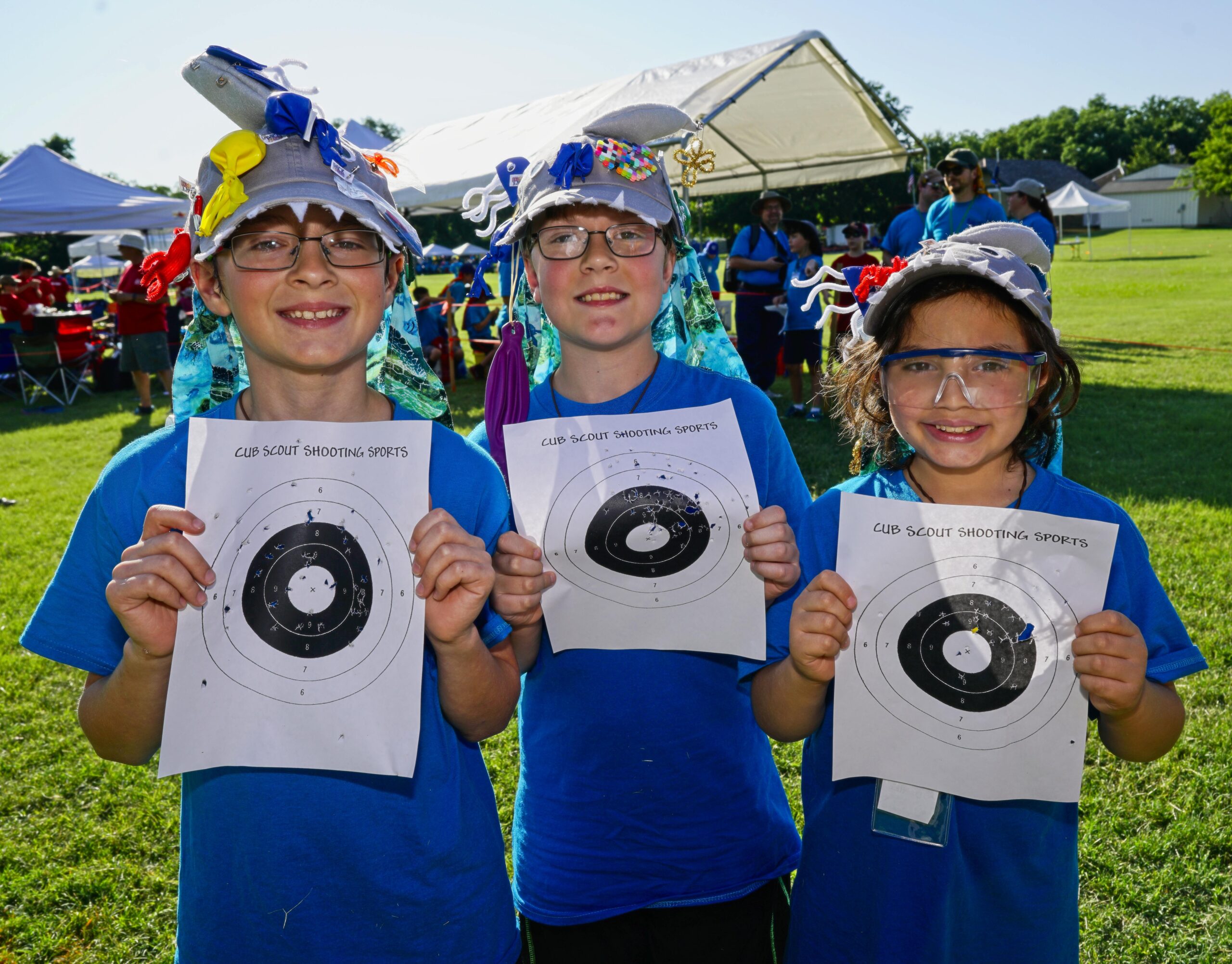
Cub Scouts at Twilight Camp – Showing targets from target practice

Range & Target Activities

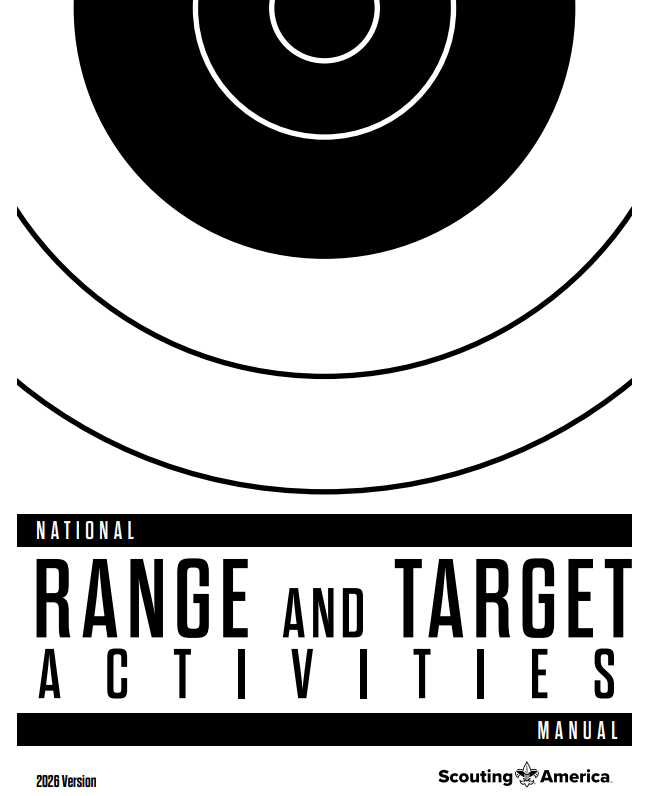
Effective January 1, 2026, Scouting America implemented the updated Range and Target Activities Manual. This revision reflects our ongoing commitment to safety, clarity, and providing engaging, age-appropriate program opportunities that meet the needs of today’s Scouts and leaders. You can find the new manual at https://stg.scouting.org/outdoor-programs/range-activities/ 

The update includes several important changes with the most notable being the addition of Atlatl as an approved program offering and the removal of the multigun airsoft program. Alongside these updates, the manual also incorporates a few other clarifications based on questions and feedback received from councils and volunteers across the country. 

Thanks to the work of the National Range and Target Activities Committee, one of the most exciting updates in the 2026 manual is the addition of Atlatl to camp programs for Scouts BSA and older youth. Councils and camps looking to diversify their range and target offerings will find Atlatl to be an accessible and engaging addition to the camp program.  

Guidance within the updated manual provides clear direction on equipment standards, range setup, supervision, and instruction that must be followed to add Atlatl to the camp program.  

As part of this update, the multigun airsoft program has been removed from the Range and Target Activities Manual. This change reflects a careful evaluation of program consistency, operational complexity, and feedback from the field. 

It is important to note that this decision does not diminish the value of airsoft experiences overall outside of Scouting. Rather, it removes a program that cannot be delivered through our current program standards. Councils are encouraged to focus on the many remaining range and target offerings that continue to provide exciting and meaningful experiences for Scouts. 

Councils and camps are encouraged to review the updated Range and Target Activities Manual as you plan camping opportunities in 2026. As always, our goal is to support safe, engaging, and memorable experiences for every Scout. This updated manual reflects that commitment while offering new opportunities like Atlatl that help our programs remain relevant.  

We look forward to seeing how councils and camps bring these updates to life in 2026 and beyond. 

See the Most Popular Content!

Subscribe to the Trail to Adventure blog
Email blast!
Subscribe to the Trail to Adventure blog
Email blast!
Chat Icon
Scoutly Toggle Size Close Chat