



Scouting America

Public Health
PublicHealth
Public Health
Merit Badge
Scouting America Merit Badge Hub
Requirement Updates 2026

This Merit Badge’s Requirements have recently been updated in 2025 Scouting America Requirements (33216). Please read more about “Requirements” on the Merit Badge Hub homepage. The previous version of the Merit Badge requirements can be found in Scoutbook.

Public Health

Merit Badge Overview

The field of public health deals with maintaining and monitoring the health of communities, and with the detection, cure, and prevention of health risks and diseases. Although public health is generally seen as a community-oriented service, it actually starts with the individual. From a single individual to the family unit to the smallest isolated rural town to the worldwide global community, one person can influence the health of many.
Public-Health_MB-overview

Public Health

Merit Badge Requirements

The previous version of the Merit Badge requirements can be found in Scoutbook

The requirements will be fed dynamically using the scout book integration
NOTE: The official merit badge pamphlets are now free and downloadable HERE or can be purchased at the Scout Shop.
2. Do the following:

5. With your parent or guardian's and counselor's approval, do ONE of the following:
  • (a) Visit a municipal wastewater treatment facility or a solid-waste management operation in your community.
  • (1) Describe how the facility safely treats and disposes of sewage or solid waste.
  • (2) Discuss your visit and what you learned with your counselor.
  • (3) Describe how sewage and solid waste should be disposed of under wilderness camping conditions.
  • (b) Visit a food service facility, such as a restaurant or school cafeteria.
  • (1) Observe food preparation, handling, and storage. Learn how the facility keeps food from becoming contaminated.
  • (2) Find out what conditions allow microorganisms to multiply in food, what can be done to help prevent them from growing and spreading, and how to kill them.
    Resource: Food Safety: Meet Bacteria (video)
  • (3) Discuss the importance of using a thermometer to check food temperatures.
    Resource: The Importance of Cooking to a Safe Internal Temperature and How To Use a Food Thermometer (video)
  • (4) Discuss your visit and what you learned with your counselor.

6. Do the following:

7. With your parent or guardian's and counselor's approval, do the following:
  • (b) After completing either 7(a)(1) or 7(a)(2), do ALL of the following:
  • (1) Compare the four leading causes of mortality (death) in your community for any of the past five years with the four leading causes of disease in your community. Explain how the public health agency you visited is trying to reduce the mortality and morbidity rates of these leading causes of illness and death.
    Resource: National Vital Statistics System (website)
  • (2) Explain the role of your health agency as it relates to the outbreak of diseases.
    Resource: How Does Public Health Tackle Outbreaks? (video)
  • (3) Discuss the kinds of public assistance the agency is able to provide in case of disasters such as floods, storms, tornadoes, earthquakes, and other acts of destruction. Your discussion can include the cleanup necessary after the disaster.
    Resource: FEMA's Role in Disaster Relief (video)

1. Do the following:
3. Discuss the importance of safe drinking water in terms of the spread of disease. Then, demonstrate two ways for making water safe to drink that can be used while at camp. In your demonstration, explain how dishes and utensils should be washed, dried, and kept sanitary at home and in camp.
Resources: Waterborne Diseases | Waterborne Pathogens | Public Health and Water Safety | Prevention & Control (video)
The Best Way to Filter Water While Backpacking (video)
How to Wash Dishes at Camp (video)
4. Explain what a vector is and how insects and rodents can be controlled in your home, in your community, and at camp. Tell why this is important. In your discussion, explain which vectors can be easily controlled by individuals and which ones require long-term, collective action.
Resource: WHO Vector Borne Disease Animation (video)
8. Pick a profession in the public health sector that interests you. Find out the education, training, and experience required to work in this profession. Discuss what you learn with your counselor.
Resources: Career in Public Health| Everything You Need to Know Public Health Careers| Healthcare Management (video)
Public Health Careers at the CDC (video)
Why Study Public Health? | College Majors | College Degrees (video)

fondo blanco liso
Public-health_MB_pamphlet
divider-graphic

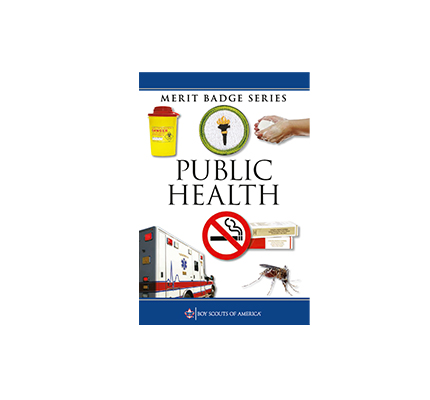
Get the Public Health Merit Badge Pamphlet

Merit Badge Pamphlets are now free and publicly available. Note: Always check stg.scouting.org/skills/merit-badges/all/ for the latest requirements.

Discover more about

"Public Health"

logo-scouting
Historically, the Public Health merit badge has been about as popular as washing dishes after a campout. (It ranked No. 120 in popularity in 2019.) But with COVID-19 on everyone’s mind, the badge is now attracting more interest. How can you teach the badge effectively and make topics like vector control, morbidity and wastewater treatment sound interesting? We talked with two Public Health merit badge counselors: Alison Williams, vice president of clinical quality improvement for the Missouri Hospital Association, and Kayland Arrington, initiative director for the Cranston (R.I.) Health Equity Zone and an epidemiologist for the Rhode Island Department of Health. Here’s what they told us. Defining Terms Scouts have to learn a lot of terminology for this badge, but perhaps the most important term appears in the badge’s name. Arrington, who holds a master’s degree in public health, thinks youth (and probably their parents) have only a hazy understanding of what public health is. “They were thinking originally that it was just sort of the government or policies,” she says of the Scouts she taught this spring. In reality, public health spans five stages: individual, interpersonal, organizational, community and public policy. “I think it’s important to highlight something at each of those levels,” she says. “What you do personally and how you can influence your friends and what your neighborhood does — all that ultimately does affect the community as a whole.” From Public to Personal Williams, a registered nurse and Scout mom, emphasizes the personal aspects of public health — and the life experiences of the Scouts she works with. For example, when she does in-person classes, she’ll set up dishwashing stations for requirement 3, which relates to waterborne illnesses and sanitation. “I also have them demonstrate how they wash their hands appropriately,” she says. Arrington says she likes to focus on the personal when she teaches Scouts. “I typically shy away from talking about personal responsibility too much in public health,” she says. “But I think it’s important for this age group to know what they are in control of, especially during a pandemic when things seem so out of control.” Going Socratic Both counselors favor the Socratic style of teaching: asking questions to discover and build on what Scouts know. And it turns out that some Scouts know a lot more than they might realize. When Arrington taught requirement 7 this spring, she spent a lot of time on automobile accidents (a leading cause of death for young people). After Scouts listed the common reasons — drunk driving, texting while driving, etc. — she posed some important questions. “I asked them, ‘Have you ever known someone who’s done these things? What can you do instead of being in those positions?’” she says. Measuring Success Will life lessons like those sink in? While it’s hard to say, Williams says she knows her Scouts are learning important information. Sometimes, it goes beyond the Scouts themselves. “I’ve actually had a lot of parents, when we did the virtual programming, who would email me back and say, ‘Thank you for doing this. I actually learned a lot myself,’” she says. “That was kind of cool to see the parents with their Scouts learning together.”
In Partnership with

View Related Merit Badges

Law
Chat Icon
Scoutly Toggle Size Close Chat
New Digital Resource Guides Available

Digital resource guides for Fingerprinting & Cycling are now available. Check them out today!