Scouting America

Mining in Society
MininginSociety
Mining in Society
Merit Badge
Scouting America Merit Badge Hub
Requirement Updates 2026

This Merit Badge’s Requirements have recently been updated in 2025 Scouting America Requirements (33216). Please read more about “Requirements” on the Merit Badge Hub homepage. The previous version of the Merit Badge requirements can be found in Scoutbook.

Mining in Society

Merit Badge Overview

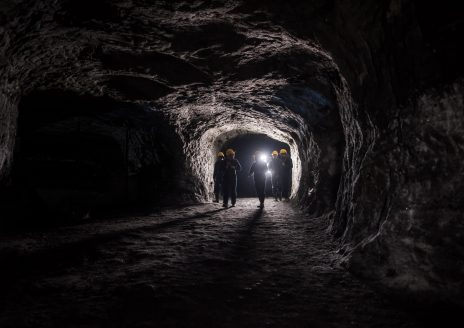
The Mining in Society merit badge covers the history of mining, explores the status of mining in the 21st century, and introduces Scouts to modern mining careers.
GettyImages-490647442-resized-for-web

Mining in Society

Merit Badge Requirements

The previous version of the Merit Badge requirements can be found in Scoutbook

The requirements will be fed dynamically using the scout book integration 147
1. Do the following:

3. Discuss with your counselor the potential hazards a miner may encounter at an active mine and the protective measures used by miners. In your discussion, explain how:

5. Do ONE of the following:
  • (a) With your parent or guardian's approval and your counselor's assistance, use the internet to find and take a virtual tour of two types of mines. Determine the similarities and differences between them regarding resource exploration, mine planning and permitting, types of equipment used, and the minerals produced. Discuss with your counselor what you learned from your internet-based mine tours.
  • (b) With your parent or guardian's permission and counselor's approval, visit a mining or minerals exhibit at a museum. Find out about the history of the museum's exhibit and the type of mining it represents. Give three examples of how mineral resources have influenced history.
  • (c) With your parent or guardian's permission and counselor's approval, visit an active mine. Find out about the tasks required to explore, plan, permit, mine, and process the resource mined at that site. Take photographs, if allowed, and request brochures from your visit. Share photos, brochures, and what you have learned with your counselor.
  • (d) With your parent or guardian's permission and counselor's approval, visit a mining equipment manufacturer or supplier. Discuss the types of equipment produced or supplied there, and in what part of the mining process this equipment is used. Take photographs if allowed, and request brochures from your visit. Share photos, brochures, and what you have learned with your counselor.
  • (e) Discuss with your counselor two methods used to reduce rock in size, one of which uses a chemical process to extract a mineral. Explain the difference between smelting and refining.
    Resources: What Is Mineral Processing? (video)
    How Gold Is Extracted From Ore | Heap Leaching Explained Step-by-Step (video)
    Materials (Part 1: Smelting and Refining Iron and Steel) (video)
    Minnesota Iron Mining Process (video)
  • (f) Learn about the history of a local mine, including what is or was mined there, how the deposit was found, the mining techniques and processes used, and how the mined resource is or was used. Find out from a historian, community leader, or business person how mining has affected your community. Note any social, cultural, or economic consequences of mining in your area. Share what you have learned with your counselor.

6. Do the following:

7. Do ONE of the following:
  • (a) Explore the anticipated benefits of interplanetary mining. Learn how NASA and private investors may search for, extract, and process minerals in outer space, and the primary reasons for mining the moon, other planets, or near-Earth asteroids. Find out how exploration and mineral processing in space differ from exploration on Earth. Share what you have learned with your counselor, and discuss the difficulties encountered in exploring, collecting, and analyzing surface or near-surface samples in space.
    Resource: Asteroid Mining: How Would It Actually Work? (video)
  • (b) Identify three minerals found dissolved in seawater or found on the ocean floor, and list three places where the ocean is mined today. Share this information with your counselor, and discuss the chief incentives for mining the oceans for minerals, the reclamation necessary after mining is over, and any special concerns when mining minerals from the ocean. Find out what sustainability problems arise from mining the oceans. Discuss what you learned with your counselor.
    Resource: Deep Sea Mining for Beginners—How Does Deep Sea Mining Work? (video)
  • (c) Learn what metals and minerals are recycled after their original use has ended. List four metals and two nonmetals, and find out how each can be recycled. Find out how recycling affects the sustainability of natural resources and how this idea is related to mining. Discuss what you learned with your counselor.
    Resource: Deep Sea Mining for Beginners—How Does Deep Sea Mining Work? (video)
    Types of Metals That Can Be Recycled (website)
    How Mining Contributes to UN SDG Part 1 (video)
    Can Recycling Metals Replace Mining? (video)
  • (d) With your parent or guardian's permission, use the internet and other resources to determine the current price of gold, copper, aluminum, or other commodities like cement or coal, and find out the five-year price trend for two of these. Report your findings to your counselor.
    Resources: Commodities (website)
    Metal Prices—100 Year Historical Chart (website)

8. Explore careers related to this merit badge. Research one career to learn about the training and education needed, costs, job prospects, salary, job duties, and career advancement. Your research methods may include—with your parent or guardian's permission—an internet or library search, an interview with a professional in the field, or a visit to a location where people in this career work. Discuss with your counselor both your findings and what about this profession might make it an interesting career.
Resources: Careers in Mining (video)
Mining and Minerals Engineering: A Day in the Life (video)
Mining Is Us: Geotechnical Engineer (video)
2. Obtain a map of your state or region showing major cities, highways, rivers, and railroads. Mark the locations of five mining enterprises. Find out what resource is processed at each location, and identify the mine as a surface or underground operation. Discuss with your counselor how the resources mined at these locations are used.

4. Discuss with your counselor the dangers someone might encounter at an abandoned mine or quarry.
Resource: Abandoned Mine Safety Training—Stay Out, Stay Alive (video)
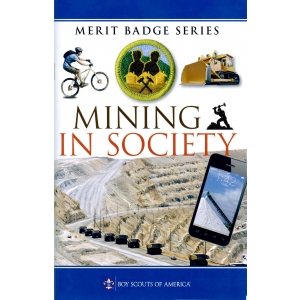
NOTE: The official merit badge pamphlets are now free and downloadable HERE or can be purchased at the Scout Shop.
fondo blanco liso
mining-in-society_MB_pamphlet-1
divider-graphic

Get the Mining in Society Merit Badge Pamphlet

Merit Badge Pamphlets are now free and publicly available. Note: Always check stg.scouting.org/skills/merit-badges/all/ for the latest requirements.

In Partnership with

View Related Merit Badges

Chat Icon
Scoutly Toggle Size Close Chat
New Digital Resource Guides Available

Digital resource guides for Fingerprinting & Cycling are now available. Check them out today!