Scouting America

Environmental Science
Merit Badge
Scouting America Merit Badge Hub
Eagle Scout insignia Eagle Required
The Digital Resource Guide for this Merit Badge is Available Now!

Explore, learn, and complete your merit badge step by step—your journey starts here!

Environmental Science

Merit Badge Overview

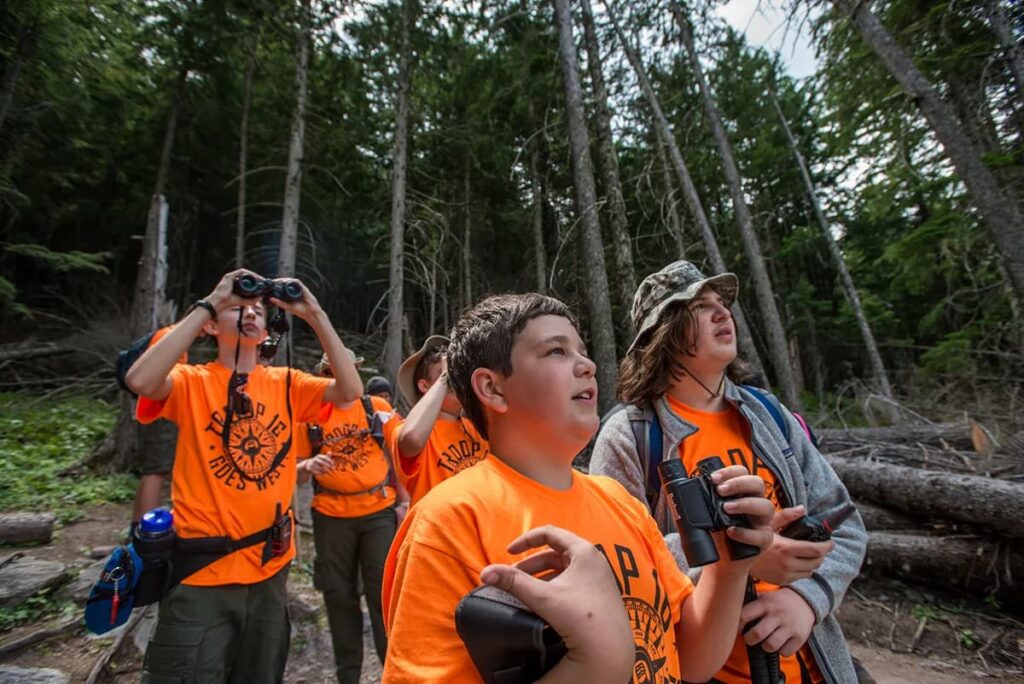
While earning the Environmental Science merit badge, Scouts will get a taste of what it is like to be an environmental scientist, making observations and carrying out experiments to investigate the natural world.
Environmental-Science_MB-overview

Environmental Science

Merit Badge Requirements

The previous version of the Merit Badge requirements can be found in Scoutbook

The requirements will be fed dynamically using the scout book integration 46
3. Air Pollution. Do ONE of the following and discuss with your counselor:
Resource: Air Pollution (video)
  • (a) Learn what Particulate Matter (PM) is, how PM gets into the air, what the harmful effects of PM are, and what is being done to reduce PM in the air. Then, perform an experiment to test for particulates that contribute to air pollution.
    Resource: Particulate Matter (video)
  • (b) Discuss how air pollution and transportation affect each other by giving at least three examples. Then, compare two modes of transportation (e.g., gasoline-powered vs. electric vehicles, gasoline-powered car vs. bicycle, etc.). Resources: Your Car's Exhaust (video)
    Air Quality and Transportation (video)
  • (c) Learn about the Clean Air Act. Make notes on when it was passed, its environmental goals, what progress has been made and what remains to be done to achieve the law's goals. Describe the impact, benefits, and costs of the law as well as what is required to implement and enforce the law.
    Resource: Clean Air Act (video)

4. Water Pollution. Do ONE of the following and discuss with your counselor:
Resource: Hydrologic Cycle (video)

1. Describe the meaning of environmental science in your own words. Explain how you think we can use science to understand, conserve, and improve our environment.
Resource: What Is Environmental Science? (video)
2. Ecology. Do the following and discuss with your counselor:
Resources: Merlin Bird App Description (app)
INaturalist App Description (app)
Observing Nature Through SMELL (video)
5. Land Pollution. Do ONE of the following and discuss with your counselor:
6. Rare, Threatened, or Endangered Species. Do ONE of the following and discuss with your counselor:

7. Pollution Prevention, Resource Recovery, and Conservation. Do ONE of the following and discuss with your counselor:

8. Pollination. Do ONE of the following and discuss with your counselor:

9. Invasive Species. In your community or camp, investigate two invasive plant or animal species. Learn where the species originated, how they were transported to this ecosystem, their life history, how they are spread, how they impact the native ecosystem, and the recommended means to eradicate or control their spread. Discuss what you learned with your counselor.
Resources: The Threat of Invasive Species (video)
Why We Don't Kill Off Invasive Species (video)
10. Identify the environmental impact topics that would need to be addressed for a construction project such as building a house, adding a new building to your Scout camp, or one you create on your own that is approved by your counselor. Evaluate the purpose and benefit of the proposed project, alternatives (including a no-action alternative), and any environmental consequences. Discuss with your counselor.
Resources: What Is an EIA? (video)
EIA issues (video)
EIAs-Key to Sustainable Development (video)
11. Identify three career opportunities that would use skills and knowledge in the environmental science field. Pick one and research the training, education, certification requirements, experience, and expenses associated with entering the field. Research the prospects for employment, starting salary, advancement opportunities and career goals associated with this career. Discuss what you learned with your counselor and whether you might be interested in this career.
Resources: EnvSci Future Careers (video)
What Do Environmental Engineers Do? (video)
What Do Environmental Scientists Do? (video)
NOTE: Check out the Digital Resource Guide for the Environmental Science merit badge HERE for information and helpful resources to engage your learning and assist you along on your merit badge journey!
The official merit badge pamphlets are now free and downloadable HERE or can be purchased at the Scout Shop. Additional educational resources are available on our Counselor Information Page.
fondo blanco liso
image-2022-11-01-15-26-32-428
divider-graphic

Get the Environmental Science Merit Badge Pamphlet

Merit Badge Pamphlets are now free and publicly available. Note: Always check stg.scouting.org/skills/merit-badges/all/ for the latest requirements.

Discover more about

"Environmental Science"

logo-onscouting-2
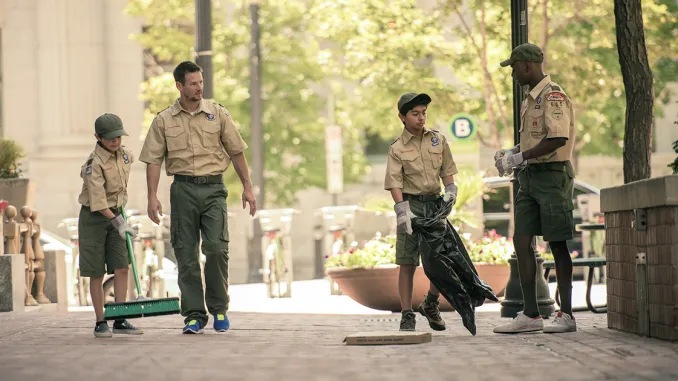
Scouts serve their communities in many ways. One popular way involves picking up litter, thereby keeping their hometowns, parks and local environments clean. Some of these efforts are global, while others have been part of awards. Every Star Scout seeking to advance to the next rank must contribute six hours of service, at least three of which must be conservation related. But what exactly does “conservation-related” mean? Does it include picking up trash?
logo-scouting
More than two decades after earning the Environmental Science merit badge, Eagle Scout Jonathan Marchal still remembers the hours he had to spend observing nature (to which he had not looked forward). “It was an incredible experience to just sit quietly in the woods,” he says. “I’m thankful that I was made to do it.” Experiences like that eventually led him to become an environmental educator. As the youth education manager at the North Carolina Arboretum in Asheville, he is now teaching the Environmental Science merit badge to a new generation of Scouts. Here are his tips for other counselors. Give Scouts Tools The study-plot requirement (requirement 4) doesn’t specify which tools, other than a journal, Scouts should take into the woods. Marchal likes to equip them with more, including field guides, binoculars, tape measures and other tools. “A really fun one is an aspirator,” he says. Something like a siphon, this device allows a Scout to suck small spiders and other objects into a jar without getting them in his mouth. “It’s a little more hands-on if you’ve got something for them to manipulate and mess around with,” he says. “And it serves as an opportunity to talk about field study and professional science, and what professional scientists use.” Make Connections Marchal likes to connect the study-plot requirement with requirement 5, in which Scouts must consider the environmental impact of a proposed construction project. For example, he’ll suggest the construction project might be a new classroom building at one of the study-plot sites. “That way, they’re familiar with all the plants and animals that are there,” he says. “If we can, we’ll go back to it and do the hypothetical construction project while we’re there so we can really visualize the erosion that might occur and that sort of thing.” Keep It Local Requirement 3 involves a series of experiments on everything from ecology to endangered species. Whenever possible, Marchal links those concepts with what’s happening locally. For example, one experiment deals with the impact of thermal pollution on aquatic life, so Marchal talks about nearby Lake Julian, which holds water discharged from a power plant. “A lot of kids know that lake is crazy warm, but not a lot of them know why,” he says. Similarly, after doing an experiment to test for particulates, he’ll talk about the particulates found in smoke. “We talk about how we like gas in our lungs, not solids,” he says. Point to the Future Marchal always promotes environmental careers (requirement 6). “I don’t know that I sat in the forest [as a Scout] and decided I was going to be an environmental educator, but Scouting definitely played a big, big role in what I ultimately decided was going to be my career,” he says. “I feel very fortunate that I was involved in Scouting.”

In Partnership with

View Related Merit Badges

Chat Icon
Scoutly Toggle Size Close Chat
New Digital Resource Guides Available

Digital resource guides for Fingerprinting & Cycling are now available. Check them out today!