4.
Location. Do the following:
- (a)
Explain how the difficulty of climbs is classified, and apply classifications to the rock faces or walls where you will demonstrate your climbing skills.
Resource: Climbing Grades Explained (video)
- (b)
Explain the following: top-rope climbing, lead climbing, and bouldering.
Resource: Top Roping vs Lead Climbing vs Bouldering (video)
- (c)
Evaluate the safety of a particular climbing area. Consider weather, visibility, the condition of the climbing surface, and any other environmental hazards.
- (d)
Determine how to summon aid to the climbing area in case of an emergency. Discuss what medical training is needed for your group when climbing and rappelling in remote areas.
5.
Verbal signals. Explain the importance of using verbal signals during every climb and rappel, and while bouldering. With the help of the counselor or another Scout, demonstrate the verbal signals used by each of the following:
Resource: Climber Communication (website)
6.
Rope. Do the following:
7.
Knots. Demonstrate the ability to tie each of the following knots. Give at least one example of how each knot is used in belaying, climbing, or rappelling.
10.
Belaying. Do the following:
1.
Do the following:
- (a)
Explain to your counselor the most likely hazards you may encounter while participating in climbing and rappelling activities and what you should do to anticipate, help prevent, mitigate, and respond to these hazards.
Resource: Risk Management in Rock Climbing (video)
- (b)
Show that you know first aid for and how to prevent injuries or illnesses that could occur during climbing activities, including heat and cold reactions, dehydration, stopped breathing, sprains, abrasions, fractures, rope burns, blisters, snakebite, concussions, and insect bites or stings.
Resources: Treatment of Rope Burns (website)
Head, Neck, and Spine Injuries (video)
First Aid for Concussions (video)
Fracture and Dislocation (video)
How To Treat A Blister Correctly (First, Look At Your Blister Roof) (video)
What Is Dehydration? Causes, Signs and Symptoms, Diagnosis and Treatment. (video)
- (c)
Identify the conditions that must exist before performing CPR on a person.
Resource: What To Do Before Starting Hands-Only CPR (video)
11.
Climbing. Do the following:
- (a)
Show the correct way to directly tie a belay rope to your harness.
- (b)
Using a carabiner and a rappel device, attach a rappel rope to your harness.
- (c)
Rappel down three different rock faces or three rappel routes on a climbing wall. Use verbal signals to communicate with a belayer, and demonstrate good rappelling technique.
13.
Demonstrate ways to store rope, hardware, and other gear used for climbing, rappelling, and belaying.
2.
Learn the Leave No Trace Seven Principles and the Outdoor Code and explain what they mean.
Resource: Leave No Trace (video)
8.
Harness, Helmet & Gloves. Explain the purpose of each of the following and demonstrate how to put them on correctly.
- (d)
Belay three different rappellers on three different routes.
- (e)
Serve as a backup belayer on three different rappels.
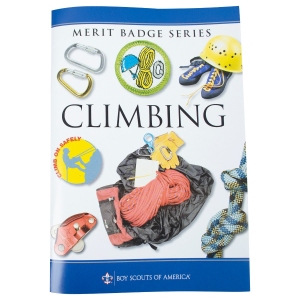
NOTE: The official merit badge pamphlets are now free and downloadable
HERE or can be purchased at the
Scout Shop.